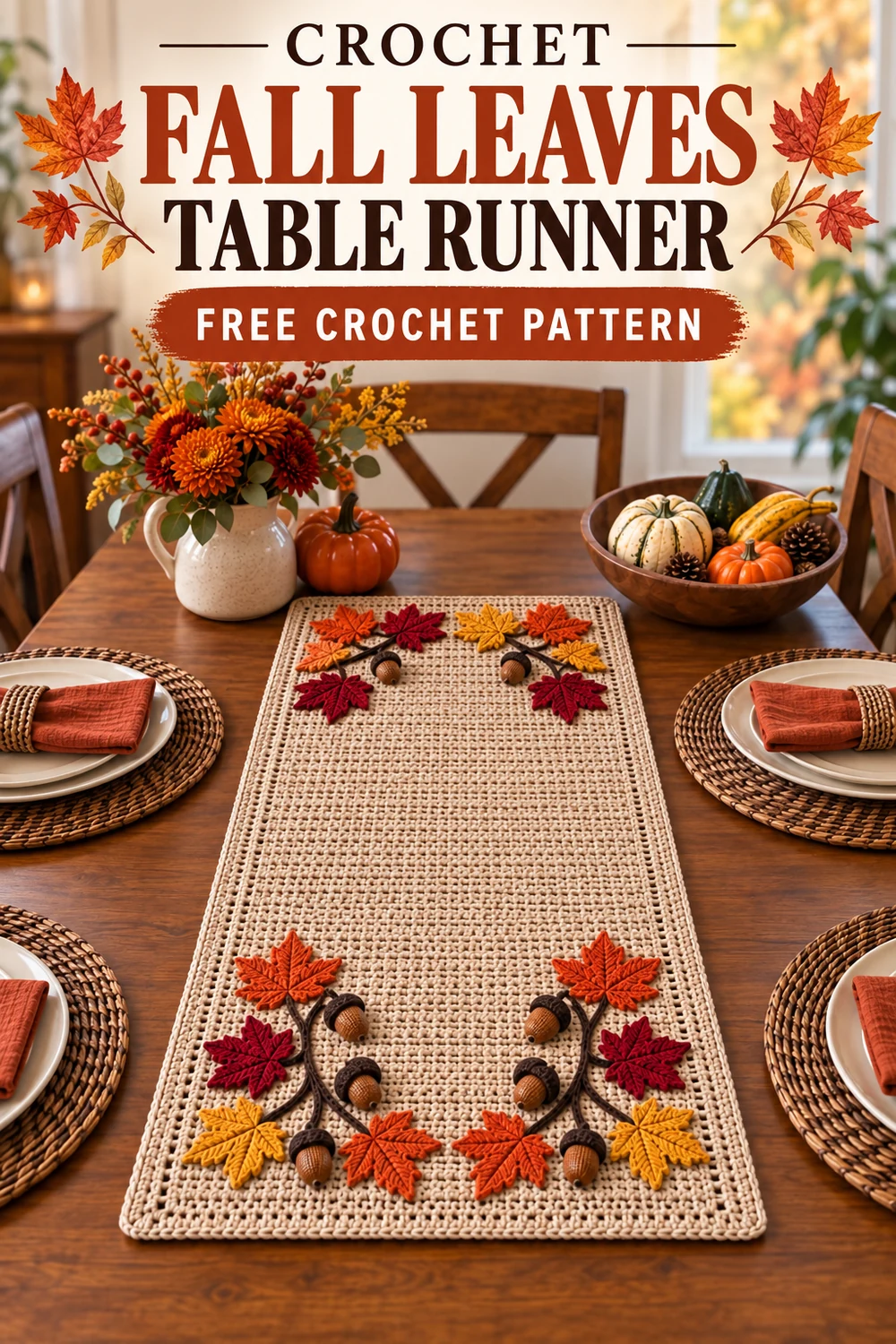
Crochet Fall Leaves Table Runner
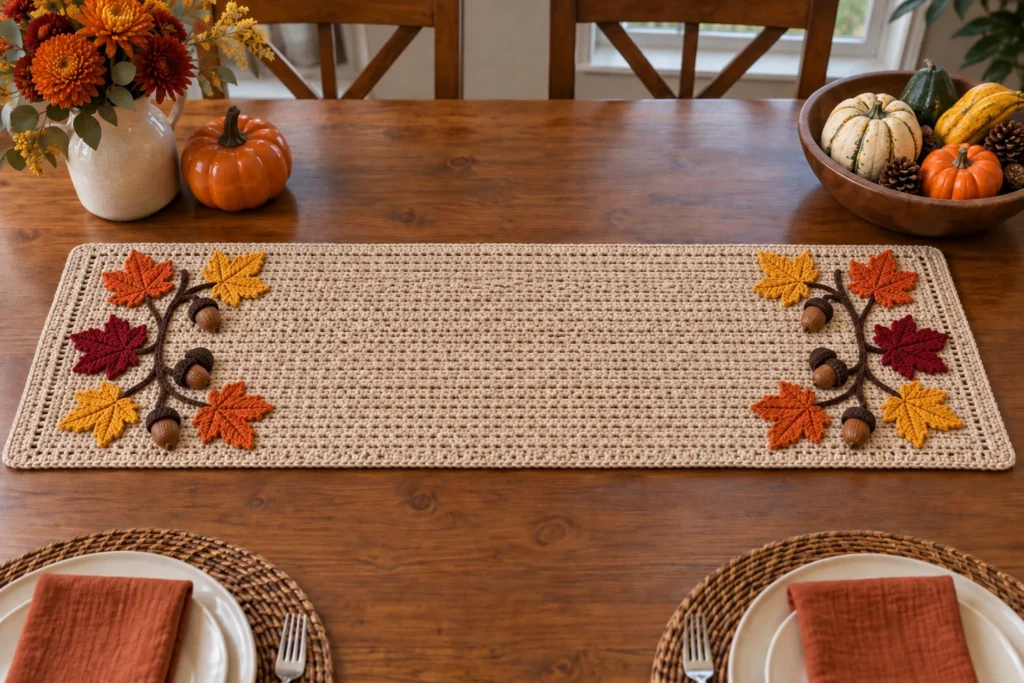
Bring warm autumn color to your table with this original crochet fall leaves table runner. The design combines an Oatmeal double-crochet panel, a neat two-round border, curved Dark Brown vines, twelve pointed leaves, and six softly stuffed acorns. The mirrored garlands decorate both ends while leaving the center open for serving dishes or a seasonal centerpiece.
Pattern at a Glance
- Skill level: Intermediate
- Terminology: US crochet terms
- Construction: One rectangular panel and border, two vine cords, twelve integral-stem leaves, six acorn nuts, and six integral-stem acorn caps
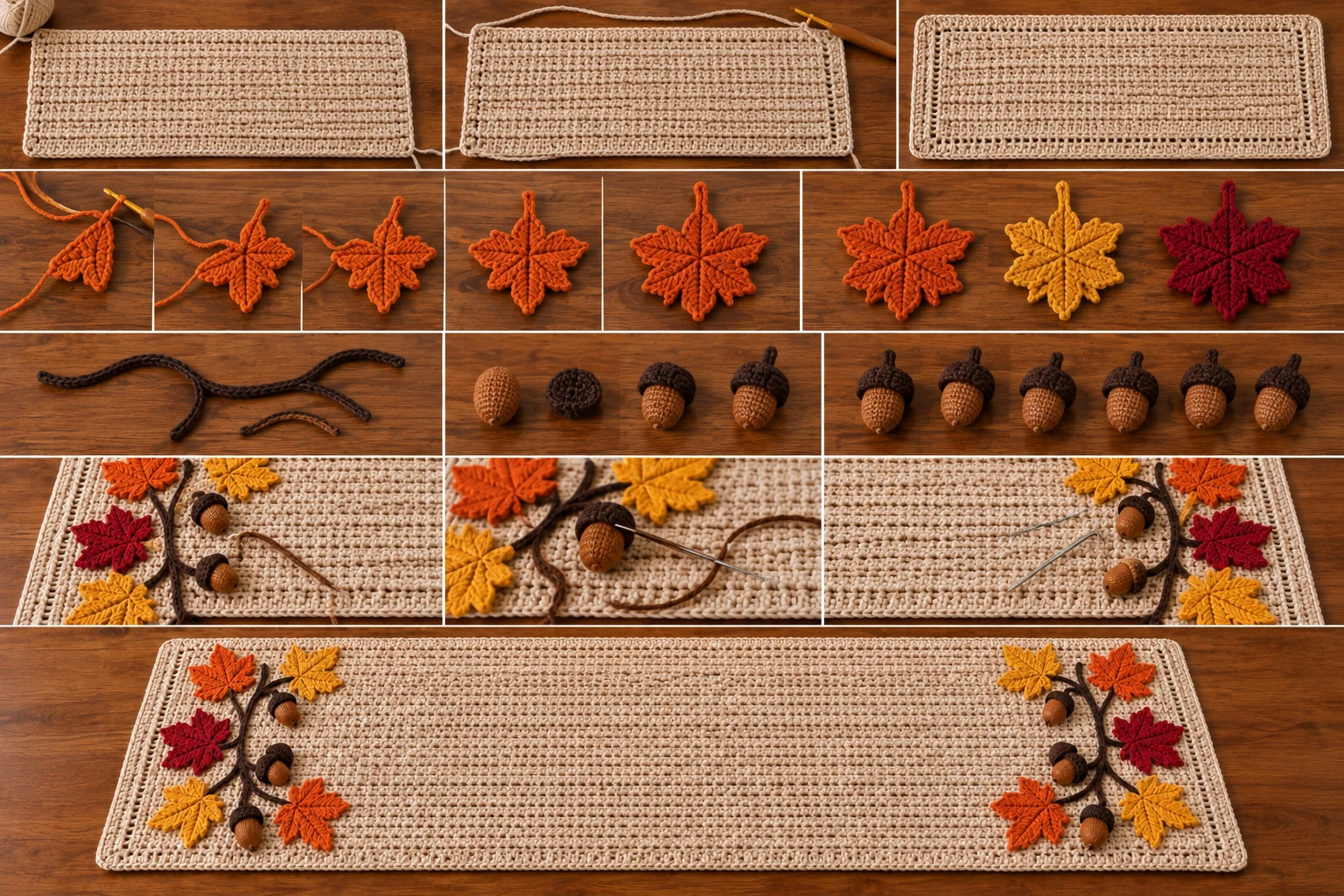
- Method: The panel is worked in turned rows, then bordered in joined rounds. The decorative components are made separately, blocked, arranged, and sewn onto the right side.
- Finished size: Approximately 30 × 12 in (76 × 30.5 cm)
- Total crocheted components: 27
Visible Component Inventory
- 1 rectangular runner panel with crocheted border in Oatmeal
- 2 curved vine connector cords in Dark Brown
- 12 integral-stem leaf appliqués: 4 Pumpkin, 4 Goldenrod, and 4 Cranberry
- 6 acorn nuts in Chestnut
- 6 acorn caps with integral stems in Dark Brown
Materials You’ll Need
- Medium/worsted-weight category 4 yarn in Oatmeal: 450 yd (412 m)
- Medium/worsted-weight category 4 yarn in Dark Brown: 80 yd (74 m)
- Medium/worsted-weight category 4 yarn in Pumpkin: 35 yd (32 m)
- Medium/worsted-weight category 4 yarn in Goldenrod: 35 yd (32 m)
- Medium/worsted-weight category 4 yarn in Cranberry: 35 yd (32 m)
- Medium/worsted-weight category 4 yarn in Chestnut: 30 yd (28 m)
- US H/8 (5 mm) crochet hook, or size needed to obtain gauge
- Removable stitch marker
- Yarn needle
- Scissors
- Rustproof T-pins
- Measuring tape
- Approximately 0.5 oz (14 g) washable polyester fiberfill
Use smooth, washable yarn of a similar fiber and thickness for every color. No buttons, wire, beads, glue, or other hardware are used.
Gauge
14 dc and 8 rows = 4 in (10 cm), measured in unblocked double crochet with the 5 mm hook.
Exact gauge matters for the finished dimensions. Make a swatch before beginning, and change hook size if necessary.
Finished Measurements
- Runner: approximately 30 in (76 cm) long × 12 in (30.5 cm) wide after blocking
- Each leaf: approximately 4.5 in (11.5 cm) long including the stem × 1.75 in (4.5 cm) wide
- Each acorn: approximately 1.25 in (3 cm) tall, excluding its stem
- Each vine: approximately 17 in (43 cm) long when relaxed and about 12 in (30.5 cm) along its sewn curve
Crochet Abbreviations
- beg = beginning
- ch = chain
- dc = double crochet
- dec = single crochet decrease
- hdc = half double crochet
- inc = 2 single crochet in the indicated stitch
- MR = magic ring
- rem = remaining
- rep = repeat
- rnd(s) = round(s)
- RS = right side
- sc = single crochet
- sl st = slip stitch
- st(s) = stitch(es)
- WS = wrong side
- yo = yarn over
Special Stitch
Sc dec: Insert hook in next st and draw up a loop, insert hook in following st and draw up a loop, yo and draw through all 3 loops.
Important Pattern Notes
- Unless instructed otherwise, turning chains count as stitches.
- Joined rounds are not turned.
- Mark the first stitch when working spiral rounds.
- Make 1 panel and border in Oatmeal, 2 vines in Dark Brown, 4 leaves in each of Pumpkin, Goldenrod, and Cranberry, 6 nuts in Chestnut, and 6 caps with stems in Dark Brown.
- Each end garland uses 2 leaves of every leaf color and 3 acorns.
- Block the panel and appliqués before assembly.
- Leave the specified long tails because they are used for sewing.
- Keep all decorations at least 0.5 in (1.3 cm) inside the outer border.
Complete Free Crochet Pattern
Component 1: Runner Panel and Border
Runner Panel
With Oatmeal, ch 103.
Row 1 (WS): Dc in 4th ch from hook; the 3 skipped chains count as the first dc. Dc in each rem chain. Turn. (101 dc)
Rows 2–31: Ch 3, counting as first dc. Skip first st and dc in each of the next 100 sts. Turn. (101 dc)
At the end of Row 31, do not turn or fasten off. The RS faces for the border.
Border
Round 1: Ch 1, which does not count as a stitch. Sc in each of the 101 sts across the top edge; ch 2 for the first corner. Work 2 sc around the end of each of the 31 rows down the first long side; ch 2. Working into the unused loops of the foundation chain, sc once opposite each of the 101 panel sts across the bottom; ch 2. Work 2 sc around the end of each of the 31 rows up the second long side; ch 2. Join with sl st to first sc. (326 sc and four ch-2 corner spaces)
Round 2: Ch 1. Sc in each sc to the first ch-2 corner space; (sc, ch 2, sc) in that space. Rep around, working 1 sc in every side sc and (sc, ch 2, sc) in each corner space. Join with sl st to first sc. (334 sc and four ch-2 corner spaces)
Fasten off, leaving a 6 in (15 cm) tail. Weave the tail securely through the WS.
Component 2: Vine Connector Cord — Make 2
With Dark Brown, ch 81. Sl st in 2nd ch from hook and in each rem ch. (80 sl sts)
Fasten off, leaving a 24 in (61 cm) sewing tail at each end. If necessary, thread a separate matching 24 in (61 cm) strand through the foundation end so both ends have sewing yarn.
Component 3: Integral-Stem Leaf Appliqué — Make 12
Make 4 Pumpkin, 4 Goldenrod, and 4 Cranberry. Ch 13.
Round 1: Sc in 2nd ch from hook, hdc in next ch, dc in next 8 ch, hdc in next ch, 5 dc in last ch. Rotate the foundation chain to work into its unused loops. Hdc in next ch, dc in next 8 ch, hdc in next ch, sc in last ch. Join with sl st to first sc. (27 sts)
Stem: Ch 8. Sl st in 2nd ch from hook and in each of the next 6 chains. (7 sl sts) Sl st into the leaf’s joining stitch to anchor the stem.
Fasten off, leaving an 18 in (46 cm) sewing tail. Weave the starting tail through the WS, but retain the long finishing tail for assembly.
Component 4: Acorn Nut — Make 6
With Chestnut, work continuously in a spiral. Mark the first stitch of each rnd.
Rnd 1: Make 6 sc in MR. (6 sc)
Rnd 2: Inc in each st around. (12 sc)
Rnd 3: Sc in each st around. (12 sc)
Rnd 4: Dec around 6 times. (6 sc)
Insert only enough washable fiberfill to round the nut without stretching the stitches. Fasten off, leaving an 18 in (46 cm) sewing tail. Thread the tail through the front loops of the 6 remaining sts, pull closed, and secure. Retain the rest of the tail for assembly.
Component 5: Acorn Cap with Integral Stem — Make 6
With Dark Brown, work joined rounds.
Rnd 1: Make 6 sc in MR; join with sl st to first sc. (6 sc)
Rnd 2: Ch 1, inc in each st around; join with sl st to first sc. (12 sc)
Stem: Ch 5. Sl st in 2nd ch from hook and in each of the next 3 chains. (4 sl sts) Sl st into the cap’s joining stitch.
Fasten off, leaving an 18 in (46 cm) sewing tail. Weave in the starting tail only.
Component 6: Assembly and Finishing
Blocking Before Assembly
Wet-block the panel to 30 × 12 in (76 × 30.5 cm), keeping the corners square. Allow it to dry fully. Lightly block the leaves and vines separately, keeping the leaves pointed and allowing each vine to retain a gentle curve. Do not flatten or block the stuffed nuts.
Acorn Assembly
Center one cap over the closed top of each nut. Using the cap’s Dark Brown tail, sew through the cap’s final-round stitches and the upper half of the Chestnut nut with small whipstitches. Keep the stem free and visible. Knot securely on the back of the acorn and bury the tail inside. Retain the Chestnut nut tail for attaching the completed acorn to its vine.
Garland Layout
Place the runner RS up with its long edges horizontal. At each short end, arrange one vine in a shallow S-curve within a 10 × 8 in (25.5 × 20.5 cm) area centered on that end. Keep every appliqué at least 0.5 in (1.3 cm) inside the outer border, and do not let any piece overlap a corner space.
Assign 6 leaves to each end: 2 Pumpkin, 2 Goldenrod, and 2 Cranberry. Position 3 leaves along the upper side of the vine and 3 along the lower side. Alternate the colors, point the tips outward, and space the 6 stems approximately evenly along the vine. Position 3 acorns in the gaps between leaf groups with their stems touching the vine.
Mirror the overall layout at the opposite end, reversing the leaf-tip directions for balanced symmetry. Pin everything before sewing. Confirm that the center 10 in (25.5 cm) section remains undecorated for serving pieces.
Assembly
- Sew each vine first. Use its Dark Brown tails and additional Dark Brown yarn as needed. Secure the vine with tiny couching stitches approximately every 0.75 in (2 cm), passing through the panel fabric without pulling it out of square. Knot on the WS and weave in securely.
- Sew the leaves. Lay each integral stem over its assigned point on the vine. With the leaf’s matching long tail, tack the stem to the vine, then sew around the entire leaf edge through the panel. Add one straight line of running stitches from the leaf base to its tip to hold the center flat and suggest a vein. Catch the panel stitches securely, avoiding long floats on the WS. Knot and weave in.
- Sew each assembled acorn last. Place its cap stem against the vine. Using the retained Chestnut tail, stitch the nut firmly to the panel around its back perimeter. Pass the tail through the vine and acorn stem twice so both are secure. Knot on the WS and weave in. Confirm that no fiberfill is exposed.
Finishing
Weave every remaining tail into the WS for at least 1.5 in (4 cm), reversing direction once. Trim only after checking every attachment. Lightly steam or mist the assembled runner without crushing the acorns, then reshape and dry flat to the stated measurements. Inspect the WS for loose loops, exposed knots, and long floats.
Customization Ideas
- Choose leaf colors that suit your décor, but retain the planned quantity of 4 leaves in each of three colors and distribute 2 of each color at both ends.
- Use a cool neutral or deep harvest shade instead of Oatmeal for the panel, keeping all yarns in the same weight and fiber family.
- For a slightly more natural composition, vary the angle of the leaf tips and acorns while preserving the specified mirrored layout, clear corner spaces, and undecorated center.
- To change the runner dimensions, swatch carefully and adjust the panel separately; the published stitch counts and border arithmetic apply only to the stated 101-stitch, 31-row panel.
Common Mistakes to Avoid
- Working into the first stitch after the turning ch-3 in the panel rows, which creates an accidental increase.
- Counting the border’s ch-1 as a stitch; it does not count.
- Missing the unused loops on the second side of a leaf’s foundation chain.
- Overstuffing the acorn nuts and exposing fiberfill between stitches.
- Sewing decorations before blocking, which can distort the panel or shift the garland layout.
- Pulling couching stitches too tightly and causing the runner to pucker.
- Letting appliqués cover the corner spaces or extend beyond the long edges.
Troubleshooting
Why does my panel keep getting narrower or wider?
Count 101 dc after every row. The ch-3 counts as the first dc, so skip the first stitch and work into the next 100 stitches.
Why does my border ripple?
Confirm that you worked exactly 2 sc around each row end along both long sides and only (sc, ch 2, sc) in each corner during Round 2. Also check that your single-crochet tension is not looser than your panel tension.
Why is a leaf asymmetrical?
Verify the sequence on both sides of the foundation chain. Each side contains the corresponding hdc and eight-dc section, while 5 dc in the last chain form the point.
Why will the vines not hold a smooth curve?
Lightly block them first, pin the complete S-curve before sewing, and distribute couching stitches approximately every 0.75 in (2 cm).
Why do the acorns wobble?
Sew around each nut’s back perimeter, then pass the retained tail through both the vine and the acorn stem twice. Do not rely on the stem alone to support the stuffed nut.
Care Instructions
Follow the care directions for the yarn used. For best results, gently hand-wash the runner in cool water with mild detergent. Support the wet fabric, press out excess water without twisting, reshape the border and appliqués, and dry flat. Avoid crushing the acorns. Store flat or loosely rolled so the leaves and dimensional pieces retain their shape.
Frequently Asked Questions
Is this pattern written in US terms?
Yes. Every stitch name and abbreviation uses US crochet terminology.
How many leaves and acorns do I need?
Make 12 leaves total—4 Pumpkin, 4 Goldenrod, and 4 Cranberry—and 6 complete acorns. Each end receives 6 leaves and 3 acorns.
Can I omit the fiberfill?
The planned design uses a small amount of fiberfill to give each acorn nut its rounded shape. Omitting it will produce a flatter component and change the intended appearance.
Can I glue the appliqués in place?
No. The construction plan uses sewn attachments only. Sewing keeps the washable pieces secure and prevents hard adhesive spots.
How is the center kept useful for serving?
The two garlands are confined to the short ends, leaving the center 10 in (25.5 cm) section undecorated.
Do I need any hardware?
No. This design contains no buttons, wire, beads, or other hardware.