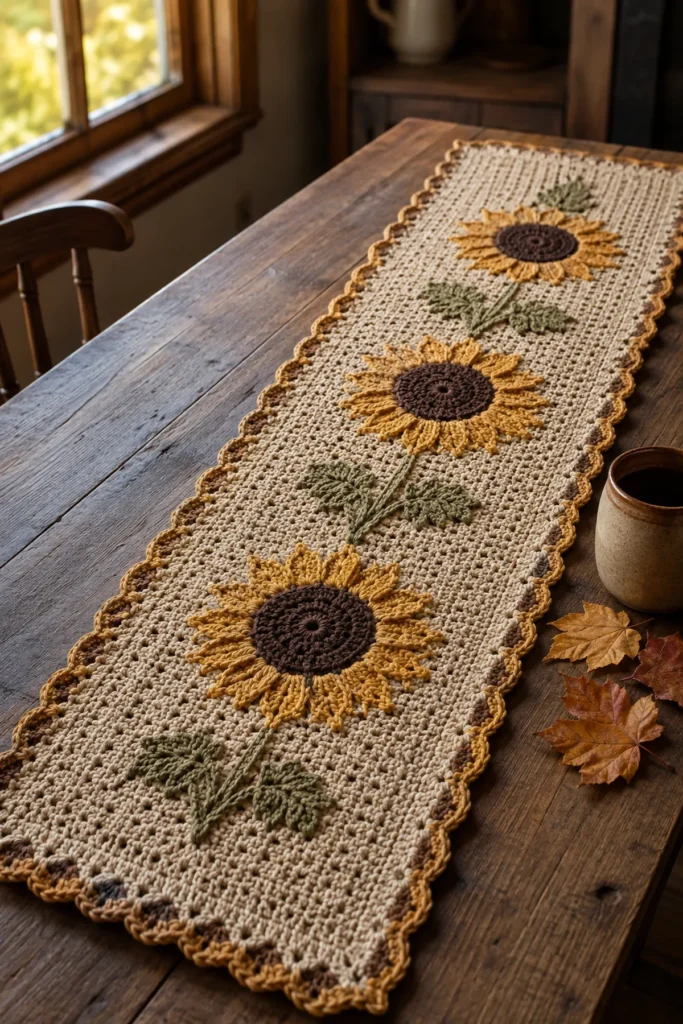
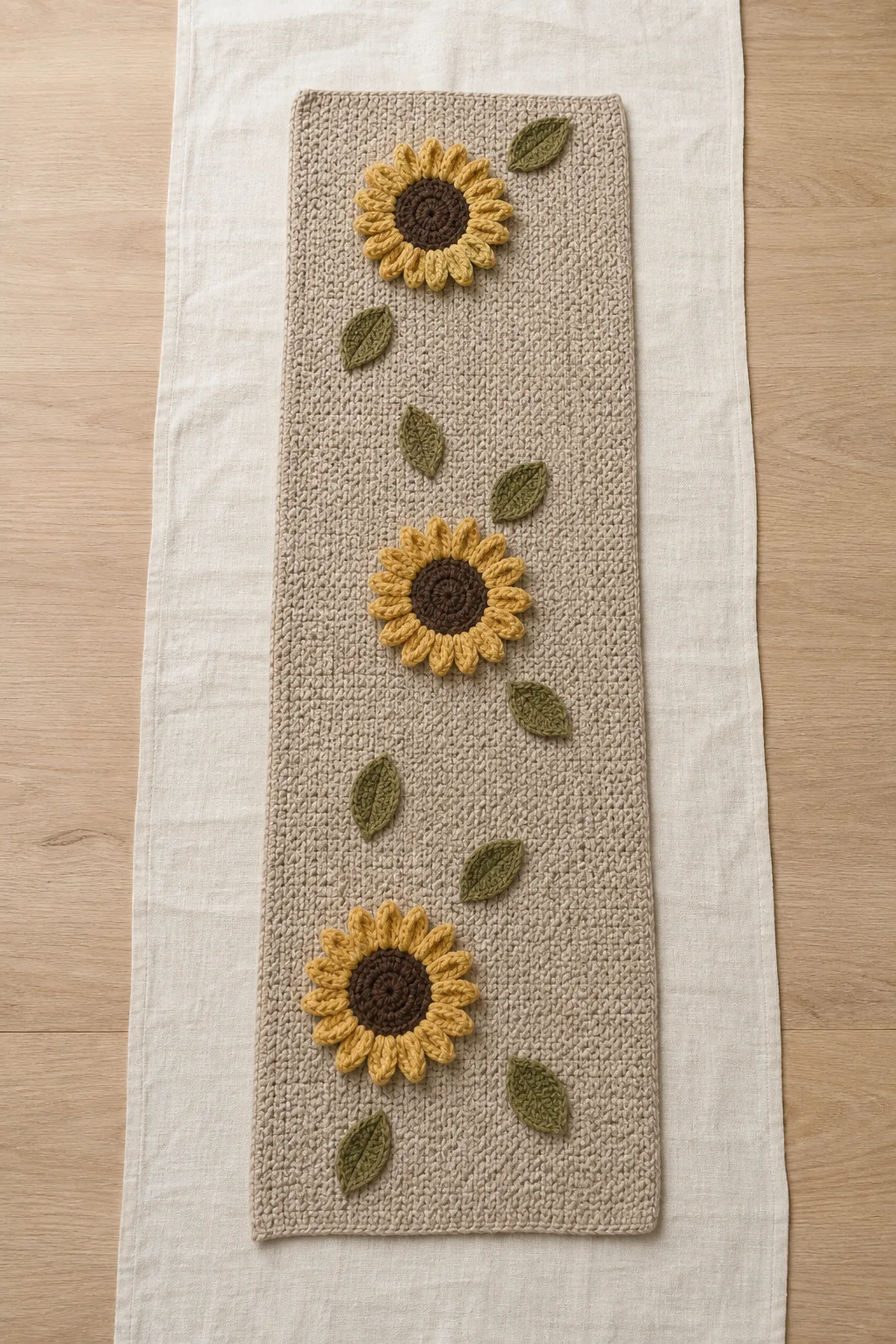
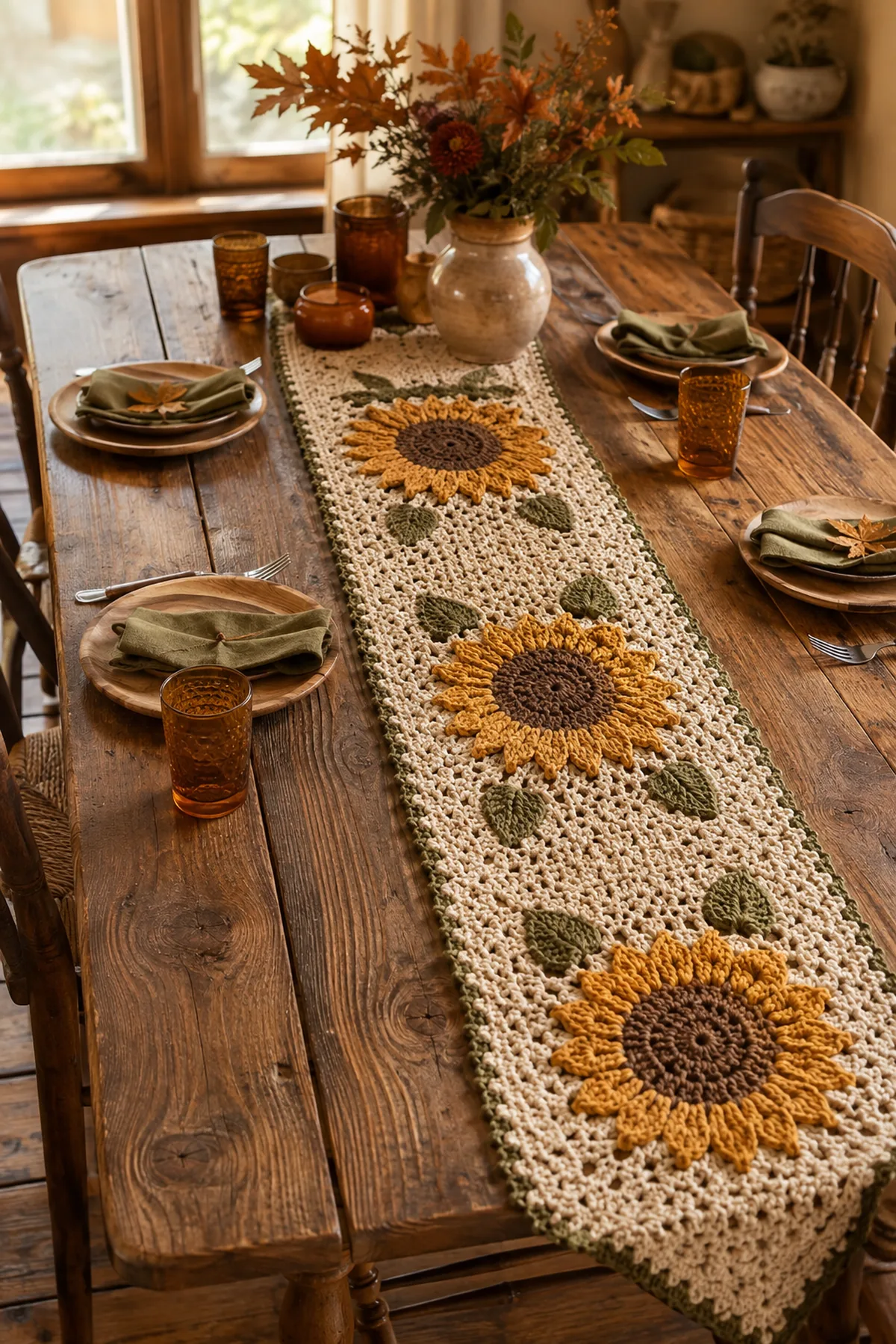
This autumn runner begins as one steady oatmeal rectangle, so its length is easy to measure and adjust before any decoration is attached. Three separately crocheted sunflowers create the focal rhythm, while olive leaves and a shallow edge soften the panel without hiding its useful table-runner shape.
Project Overview
An elongated oatmeal runner with three spaced golden sunflowers, brown centers, olive leaves and a restrained scalloped border.
This design is mathematically checked but has not been physically sample-tested. Make and measure a swatch or first component, adjust for your yarn and tension, and review the finished draft before publication.
Pattern Details
- Skill Level: Intermediate
- Yarn Weight: Worsted
- Hook Size: 4 mm
- Finished Size: Panel about 11 in by 45 in / 28 by 114 cm before border
- Gauge: 16 hdc and 8 rows = 4 in / 10 cm after blocking
- Terminology: US
- Estimated Time: 12–16 hours
Materials
- Approximately 850 yd / 780 m worsted cotton: 600 yd oatmeal, 120 yd golden yellow, 70 yd brown and 60 yd olive
- 4 mm crochet hook, or size needed for gauge
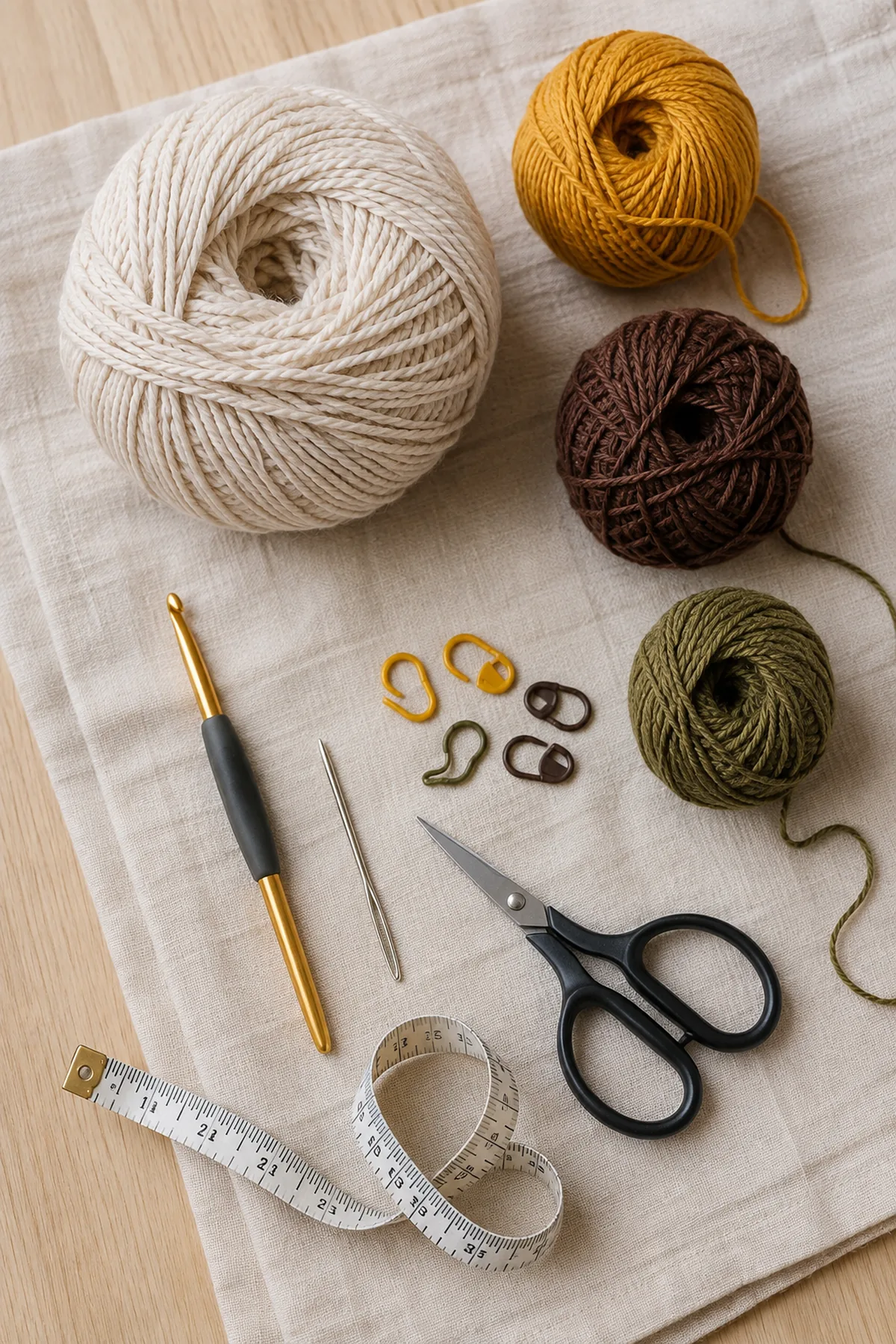
- Tapestry needle, scissors, stitch markers, measuring tape, blocking mats and rustproof pins
Abbreviations
- ch = chain
- sc = single crochet
- hdc = half double crochet
- dc = double crochet
- tr = treble crochet
- sl st = slip stitch
- st(s) = stitch(es)
- sc2tog = single crochet two together
Important Notes
- Chain 2 never counts as a stitch
- Keep 44 half double crochet stitches in every panel row
- Alternate back-loop and front-loop rows for subtle ridges
- Measure and block the runner before placing motifs
- Use as a decorative textile only; protect it from hot cookware and candle flame
Crochet the Long Runner Panel
With oatmeal, ch 46. Row 1: Hdc in the third chain from the hook and in each chain across. (44 sts)
Row 2: Ch 2, turn. Hdc in the back loop of every stitch. (44 sts)
Rows 3–89: Ch 2 and turn after each row. On odd-numbered rows work hdc in the front loop of every stitch; on even-numbered rows work hdc in the back loop of every stitch. Keep the first and last stitch marked and count each row. (44 sts in each row)
Row 90: Ch 2, turn and hdc in the back loop of every stitch. Fasten off. (44 sts)
The completed panel contains 3,960 hdc stitches. Measure before adding motifs. Add or remove rows in pairs if you need a different length, ending with an even row.
Make Three Sunflowers
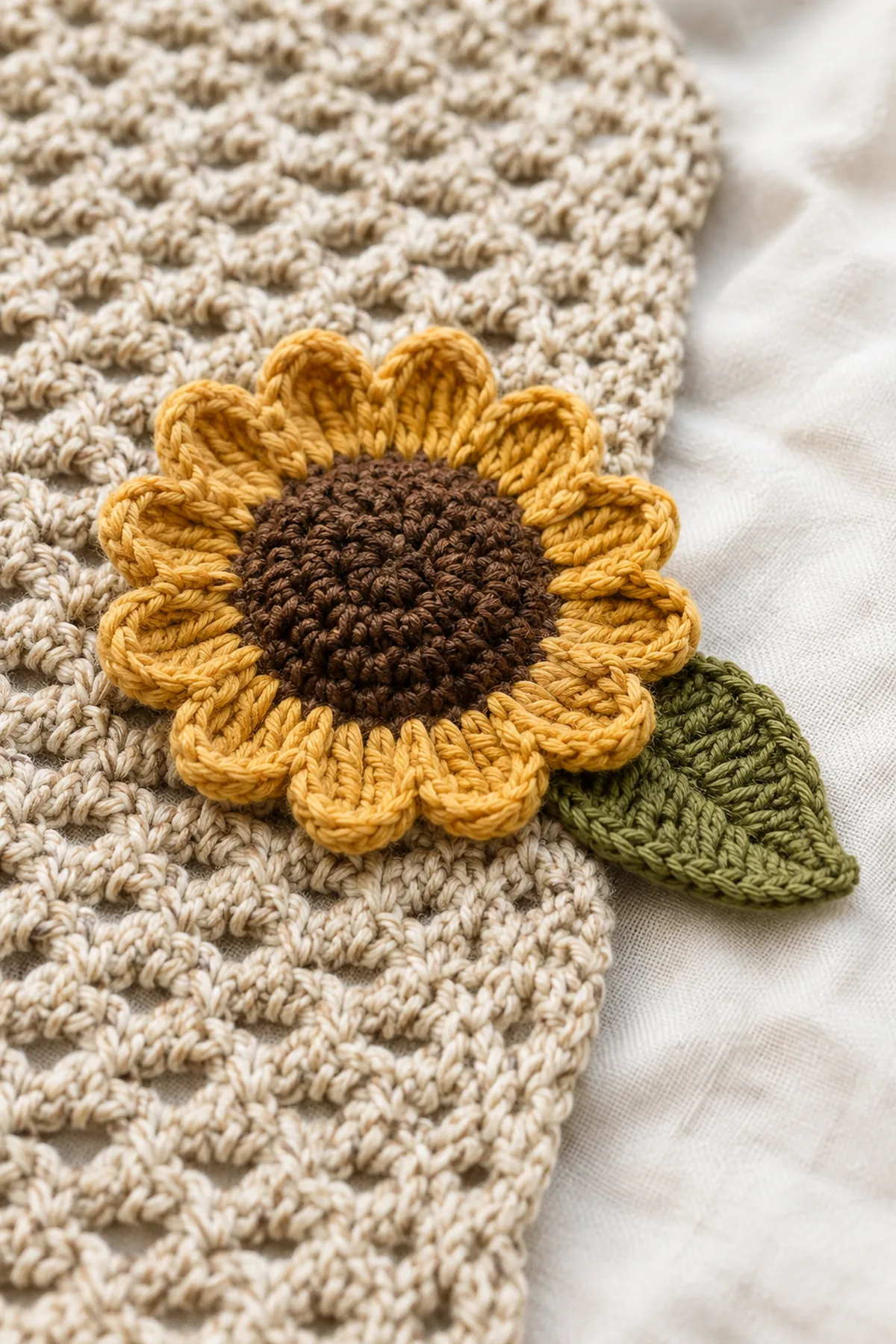
With brown, make an adjustable ring and work 12 sc; join. Rnd 2: Work 2 puff stitches in each stitch, separated by ch 1, for 24 puffs. Fasten off. Join gold in any chain space. Repeat [slip stitch in the space, ch 4, 2 tr in the same space, ch 4, slip stitch in the same space] in all 24 spaces to form 24 petals. Fasten off. Make three matching flowers and block each to about 6 inches across.
Make Six Olive Leaves
For each leaf, ch 12. Starting in the second chain, work sl st, sc, hdc, dc in next 3 chains, hdc in next 2, sc, sl st; ch 1 at the tip. Work back along the unused side of the chain in reverse order. Join at the base and leave a sewing tail.
Arrange and Attach
Mark the runner center and points 13 inches to either side. Center one flower over each point. Angle two leaves beside every flower. Pin the pieces, confirm that the long edges remain straight, then sew through the back loops of each motif and only the top bars of the runner stitches. Keep all sewing invisible from the front.
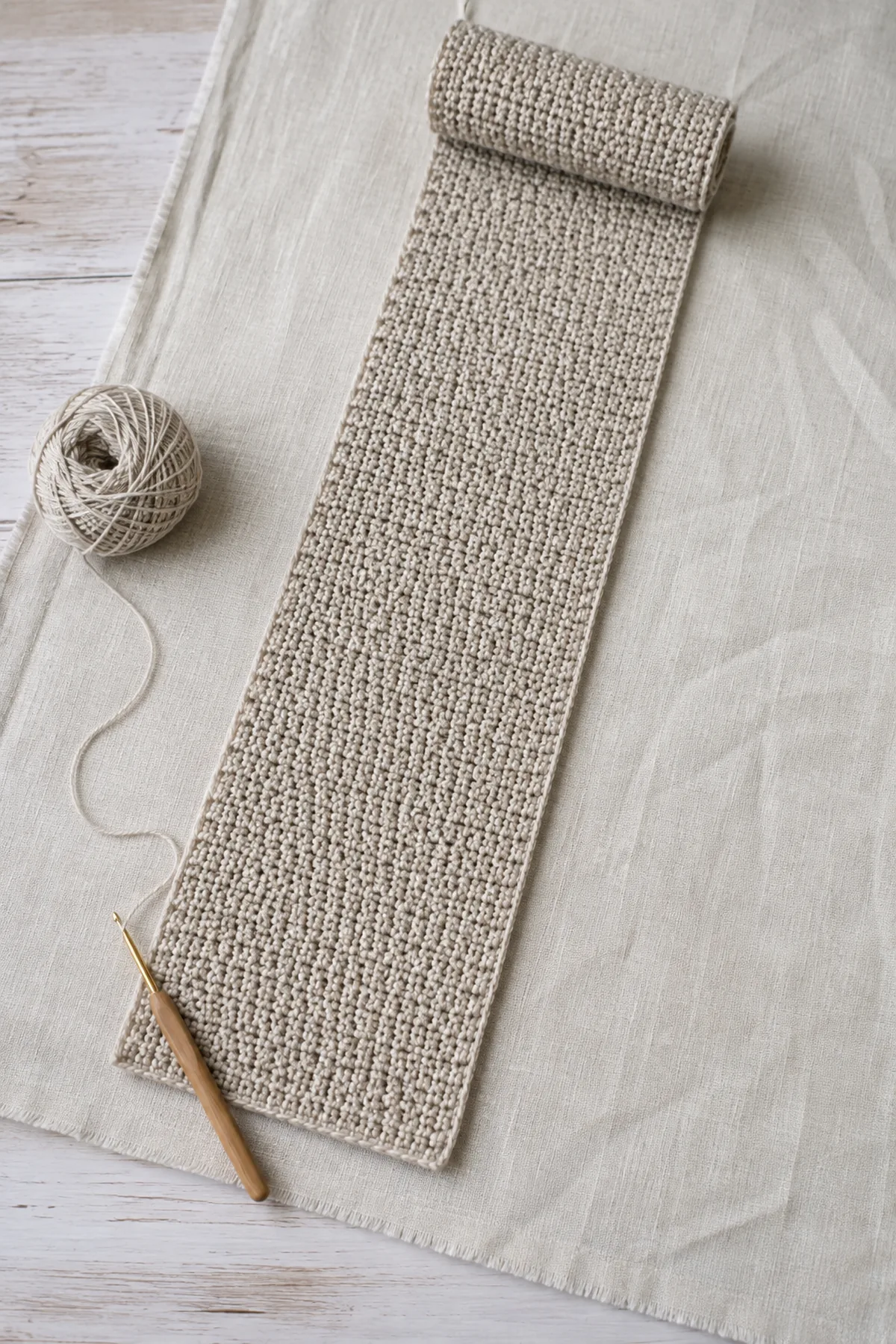
The early-stage image is a generated construction illustration. Use the written stitch counts as the working reference.
Finishing
Join oatmeal at a corner and single crochet evenly around, placing 3 sc in each corner. On the long sides, aim for about two stitches per three row ends and adjust locally so the edge lies flat. Join. For a shallow scallop, repeat [skip 2, 5 dc in next stitch, skip 2, slip stitch in next stitch], easing at corners. Wet-block to the planned table size and dry completely.
Customization Ideas
- Make a shorter console runner by removing panel rows in pairs before adding motifs
- Use rust petals on the end flowers and gold only at the center for stronger autumn contrast
- Omit the scalloped border and work one firm single-crochet round for a modern edge
Care and Display
Follow the yarn label, test saturated colors for transfer and dry the piece in its intended shape. Keep decorative crochet away from flame, hot bulbs, moisture and snagging hardware. Inspect hanging loops and sewn details before each seasonal display.
Troubleshooting
- Count at the end of every row or round and correct the first mismatch immediately.
- If the fabric twists unexpectedly, confirm the foundation orientation and the marked first stitch before continuing.
- When a join puckers, remove the stitches and resew with relaxed, even tension rather than stretching the finished fabric.
Frequently Asked Questions
Why are the long edges rippling?
The row-end edging rate may be too dense. Remove it and use fewer evenly spaced stitches before working the scallops.
Can I wash the runner?
Follow the yarn label, use cool water when possible, reshape flat and dry fully. Test dark colors for dye transfer first.
Can it protect my table from heat?
No. It is decorative and has not been tested as a heat barrier.
Before You Finish
Compare the completed piece with the measurements and construction notes, photograph any adjustment and record it before making another. Because this is an untested draft, physically sample and review the project before public release.