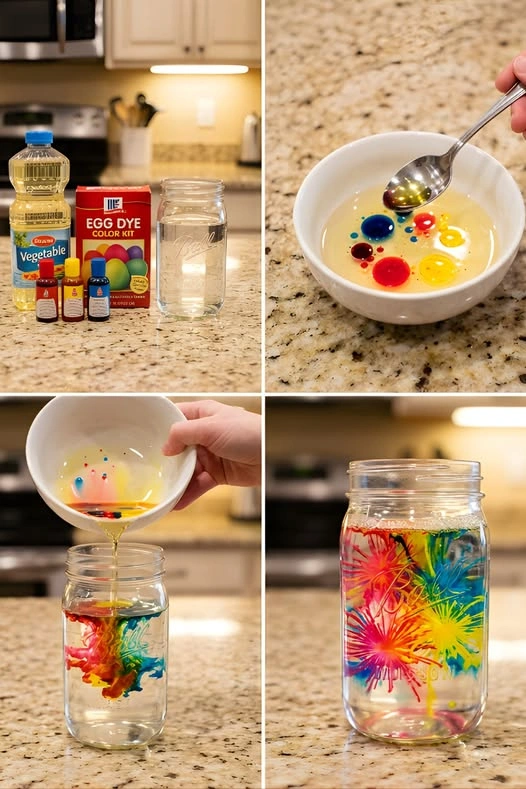
If you’ve ever searched for a kids’ activity that’s equal parts easy, beautiful, and educational, you’ve just found your new go-to. Sparkling Color Fireworks in a Jar is one of those rare experiments that takes less than five minutes to set up but delivers minutes — sometimes hours — of pure wonder. Watch as swirling ribbons of color drift and sink through oil in slow, hypnotic bursts, looking for all the world like tiny fireworks exploding in slow motion.
This activity is perfect for rainy afternoons, curious toddlers, bored school-age kids, or anyone who wants to sneak a little science into a fun moment at home. And the best part? Everything you need is probably already in your kitchen.
What Is the Fireworks in a Jar Experiment?
Fireworks in a Jar is a classic kitchen science experiment that uses the natural properties of oil and water — and a few drops of food coloring — to create a stunning visual effect. When food coloring is dropped into oil and then poured into water, something remarkable happens: the coloring sinks through the oil in droplets, enters the water, and then blooms and swirls outward in colorful bursts that look like miniature fireworks.
It’s a simple concept, but the result genuinely feels like magic.
This experiment has been around for years in science education circles, but it’s having a well-deserved renaissance on social media and in sensory play communities — and for good reason. It’s accessible to all ages, requires zero special equipment, and opens the door to rich conversations about science with even the youngest children.
What You’ll Need
Before you get started, gather these simple supplies:
- A clear jar — A mason jar, large glass, or any transparent container works perfectly. The clarity is important so you can see the full effect.
- Warm water — Warm (not boiling) water is ideal. It helps the food coloring disperse slightly more readily.
- Vegetable oil — Any standard cooking oil works. Vegetable oil is most commonly used because it’s affordable, clear, and readily available.
- Food coloring in multiple colors — The more colors, the more spectacular the effect. Liquid food coloring works best.
- A small bowl or cup — You’ll need a separate vessel to mix the oil and coloring before adding it to the water.
- A spoon or toothpick — Just for a very gentle stir.
That’s it. No special lab equipment, no specialty craft supplies, no trip to the store required.
Step-by-Step Instructions
Step 1: Fill the Jar with Warm Water
Fill your clear jar about three-quarters of the way full with warm water. You want to leave some room at the top so the oil mixture doesn’t overflow when you pour it in. The warm temperature isn’t strictly necessary, but it helps the experiment look its best.
Step 2: Prepare the Oil Mixture
In a small, separate bowl, pour a few tablespoons of vegetable oil. You don’t need a lot — just enough to carry the food coloring into the jar.
Step 3: Add the Food Coloring
Drop several colors of food coloring directly into the oil. Go a little generous here — three to five drops of each color gives a beautiful, vivid result. The coloring will bead up in the oil because, as we’ll explain in a moment, oil and water-based dye don’t mix.
Step 4: Gently Stir — But Not Too Much
Using a spoon or toothpick, give the oil-and-coloring mixture a very gentle stir. You’re not trying to blend the colors together — just break up the larger drops into smaller ones. Think of it less as stirring and more as nudging. If you overmix, you’ll end up with a muddled color rather than distinct bursts.
Step 5: Pour the Oil Mixture into the Jar
Slowly and carefully pour the oil mixture over the surface of the water. Pour it gently — you can even tilt the jar slightly to help the oil spread across the top.
Step 6: Watch the Magic Happen
Now just wait and watch. Within seconds, you’ll begin to see the food coloring drops sink through the oil layer, hit the water, and bloom outward in gorgeous swirling bursts. The effect is slow, mesmerizing, and repeatable as the colors continue to move and blend in the water below.
Sit back, let the kids gather close, and enjoy the show.
The Science Behind the Magic
While this experiment looks like pure magic, there’s fascinating and teachable science at work. Here’s what’s really happening — broken down so you can explain it to kids of any age.
Oil and Water Don’t Mix
This is the foundation of the whole experiment. Oil and water are immiscible, meaning they don’t mix together. This happens because of molecular polarity. Water molecules are polar — they have a slight positive charge on one end and a slight negative charge on the other. Oil molecules are nonpolar — they have no charge separation.
The rule in chemistry is “like dissolves like,” which means polar substances mix with polar substances, and nonpolar substances mix with nonpolar substances. Because water and oil have opposite polarities, they simply refuse to combine, no matter how vigorously you stir them. The oil always rises to the top because it is less dense than water.
Food Coloring Is Water-Based
Food coloring is made with water as a base, making it polar — just like water. This means it won’t dissolve into the oil either. When you drop food coloring into the oil, it beads up and floats around in tiny droplets, refusing to blend.
Gravity Does the Work
When the oil mixture is poured into the jar, the coloring droplets are temporarily suspended in oil that’s sitting on top of the denser water. Gravity pulls the heavier coloring drops downward. Because they’re water-based, once they reach the oil-water boundary, they slip through into the water below — and that’s the moment you see the burst of color.
The “Fireworks” Effect
As each coloring droplet enters the water, it rapidly disperses in a bloom of color — exactly like a firework exploding in the sky. The colors continue to swirl and mix as new drops follow behind, creating the slow, drifting display that makes this experiment so irresistible to watch.
Why This Activity Is Great for Kids
It’s Genuinely Educational
Without any formal lesson or instruction, this experiment teaches children about density, polarity, and the behavior of liquids. Simply watching and asking “why do you think that happened?” can spark a conversation about the science of oil and water that sticks far longer than any worksheet.
It Builds Observation Skills
Science isn’t just about conducting experiments — it’s about watching carefully and noticing patterns. Fireworks in a Jar encourages kids to observe, describe what they see, and form simple hypotheses. (“What do you think will happen if we add more coloring? What about less oil?”)
It’s Sensory and Calming
There’s something deeply soothing about watching colors slowly drift and swirl through water. For kids who benefit from calm, visually engaging activities — including children with sensory sensitivities or those who struggle to slow down — this experiment offers a rare moment of quiet fascination.
It Works for a Wide Age Range
Toddlers are mesmerized by the swirling colors. Elementary-age children love the “experiment” framing and the opportunity to make predictions. Older kids and teens can dig into the chemistry behind it. This is one of those rare activities that genuinely works across a wide age range.
It’s Repeatable
Unlike many one-and-done experiments, this one can be reset and repeated. You can try different color combinations, vary the amount of oil, or use cold water versus warm water to observe any differences. Each variation teaches something slightly different.
Tips to Make It Even Better
Use bold, contrasting colors. Red, blue, and yellow create vivid bursts. Avoid using too many similar shades together, as they can blend into a muddy brown.
Try different liquids. What happens if you use baby oil instead of vegetable oil? Mineral oil? Each has a slightly different viscosity, which affects how the coloring drops fall.
Experiment with temperature. Try cold water versus warm water and see if the effect differs. (Hint: temperature affects how quickly the coloring disperses.)
Add glitter. For an extra sparkle effect that really leans into the fireworks theme, add a small pinch of glitter to the oil mixture before pouring.
Try it in a tall, narrow container. A vase or tall drinking glass gives the colors more room to fall and swirl, creating an even more dramatic effect.
Use a flashlight. Shining a flashlight behind or beneath the jar while the colors swirl makes the whole thing glow beautifully — especially in a darkened room.
Variations to Try
Rainbow Fireworks: Use red, orange, yellow, green, blue, and purple food coloring to create a full rainbow effect. The colors will blend at the edges in unexpected and beautiful ways.
Holiday Colors: Tailor the color palette to a season or holiday — red and green for Christmas, orange and black for Halloween, red, white, and blue for the Fourth of July.
Density Tower Add-On: Before adding the oil, layer other liquids of different densities (like corn syrup, dish soap, and water) in the jar to create a rainbow density column, then add the oil and coloring on top for an even more dramatic display.
Photography Project: Set up a phone or camera in front of the jar and capture the moment the colors bloom. The slow-motion video setting on most smartphones creates absolutely stunning results.
How to Talk to Kids About What They’re Seeing
You don’t need to deliver a science lecture to make this educational. Just asking open-ended questions while you watch together is enough:
- “What do you notice happening when the coloring hits the water?”
- “Why do you think the oil stays on top?”
- “What would happen if we stirred the jar really fast?”
- “Can you describe the shapes the colors are making?”
- “Which color do you think will spread the farthest?”
These simple questions encourage critical thinking, vocabulary development, and scientific curiosity — all while you’re doing something that looks and feels like pure play.
Cleanup and Safety Notes
This activity is very safe for all ages. Food coloring, oil, and water are all non-toxic household items. That said, food coloring can stain clothing, countertops, and skin, so it’s worth covering your work surface with a paper towel or doing the activity over a sink.
Cleanup is simple: the oil and water can go down the drain, and the jar can be rinsed with dish soap and hot water.
If small children are involved, supervise closely as you would with any water activity. The oil can make surfaces slippery if spilled.
Final Thoughts
Sparkling Color Fireworks in a Jar is one of those activities that earns a permanent spot in your rainy-day rotation. It requires almost nothing to set up, delivers a stunning payoff, and opens the door to real scientific conversation — all without anyone realizing they’re “learning.”
Whether you’re a parent looking for a quick afternoon activity, a teacher searching for a classroom demonstration, or a curious adult who just loves a good kitchen experiment, this one delivers every single time. The colors sink, the fireworks bloom, and — without fail — someone always leans in and says, “Wait… do it again.”
Set it up. Watch closely. And enjoy the magic.