There’s something quietly extraordinary about putting a simple flower into a jar of water before bed and waking up the next morning to find it covered — completely, delicately, impossibly — in thousands of tiny sparkling crystals.
Crystal flowers are one of those rare activities that sit exactly at the intersection of science and wonder. They’re simple enough to set up in ten minutes. They require just three ingredients. And the results are so beautiful — so genuinely, unexpectedly stunning — that adults are just as mesmerized as children when they see them for the first time.
This is a make-it-before-bedtime, wake-up-to-magic kind of project. You do the work in the evening. Overnight, chemistry does the rest. And in the morning, you discover something that looks like it was pulled from an enchanted garden — petals coated in glittering, light-catching crystals that turn an ordinary flower into a shimmering treasure.
Here’s the complete guide to making crystal flowers at home, including everything you need to know about the science behind the magic, tips for the most dazzling results, and ideas for taking your crystals even further.
What Are Crystal Flowers?
Crystal flowers are real flowers — or any natural material like leaves, pinecones, or pipe cleaner flowers — that have been coated in borax crystals through a process called crystallization. When a borax solution is prepared and a flower is submerged in it overnight, borax molecules slowly arrange themselves into beautiful geometric crystal structures on every surface of the flower. By morning, every petal, every stem, every tiny detail is covered in a glittering crust of crystals that catches and scatters light like a miniature chandelier.
The flower itself becomes a scaffold — a structure for the crystals to grow on and around. The result is something that looks delicate and impossibly intricate, as though the flower has been dipped in diamonds or frozen in the middle of a winter frost.
They make beautiful home decorations, remarkable photography subjects, unique handmade gifts, and one of the most memorable science activities you can do with a child. Once you’ve made a crystal flower, the desire to crystallize everything else in the house is almost irresistible.
What You’ll Need
The supply list is beautifully short:
- Hot water — The hotter the better, as heat allows more borax to dissolve into the water, which produces more dramatic and abundant crystal growth.
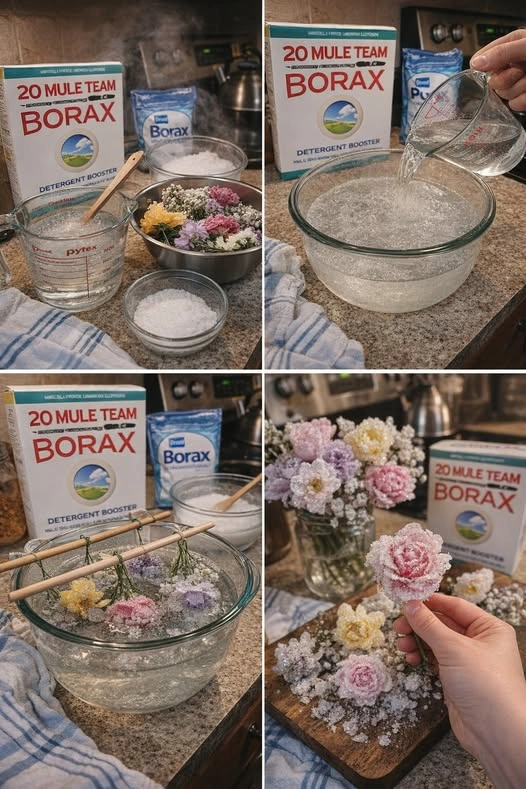
- Borax — A natural mineral powder widely available in the laundry aisle of most grocery and hardware stores (commonly sold as “20 Mule Team Borax”). It is the crystallizing agent that creates the magical coating.
- Flowers — Fresh flowers work wonderfully, as do artificial flowers, pipe cleaner flowers, leaves, small branches, or any natural or craft material with surface texture for crystals to grip.
Optional but helpful: a jar or container large enough to submerge your flower, a pencil or stick to suspend the flower in the solution (more on this below), string or pipe cleaner to tie the flower to the pencil, and food coloring if you want to tint your crystals.
Step-by-Step Instructions
Step 1: Prepare Your Magic Potion
Bring water to a boil — a kettle works perfectly for this. Carefully pour the hot water into your jar or container. The amount of water you need depends on the size of your container and how large your flower is, but a general rule is to fill the container enough that your flower can be fully submerged.
Now add borax. The ratio is approximately three tablespoons of borax per cup of hot water. Add the borax a tablespoon at a time, stirring gently after each addition until it dissolves completely before adding more. Keep adding and stirring until no more borax will dissolve — you’ll know you’ve reached the saturation point when borax powder starts to settle at the bottom of the jar rather than dissolving.
This saturated solution is your magic potion. The higher the concentration of borax dissolved in the water, the more dramatic and abundant the crystal growth will be overnight.
If you want colored crystals, add several drops of food coloring to the solution now and stir to combine. The crystals will take on a soft, translucent tint of your chosen color — beautiful and entirely customizable.
Step 2: Prepare and Submerge Your Flower
Trim your flower’s stem to a length that allows it to hang inside the jar without resting on the bottom. The flower should be fully submerged in the solution but ideally not touching the sides or bottom of the container — any surface the flower rests against will have fewer crystals and may stick.
The best technique is to tie a length of string to the flower’s stem and then tie the other end to a pencil or stick laid across the top of the jar. This suspends the flower in the middle of the solution, surrounded by liquid on all sides, allowing crystals to grow uniformly across every surface.
Gently lower the flower into the still-hot borax solution. You’ll notice the water is slightly cloudy or hazy — that’s the high concentration of dissolved borax, and it’s a good sign.
Step 3: Set Aside and Let the Magic Happen
Place the jar somewhere it won’t be disturbed overnight — a kitchen counter, a shelf, or a windowsill all work well. Avoid moving or jostling the jar while the crystals are growing, as vibration can disrupt the crystallization process and result in smaller, less uniform crystals.
Now the best part: there’s nothing left to do. Go about your evening. Read a book. Watch a film. Sleep. While you’re not looking, chemistry is quietly working, building something extraordinary crystal by crystal, layer by layer, in the stillness of your kitchen.
Step 4: Wake Up to a Beautiful Sight
In the morning — or after at least eight hours, ideally longer — carefully lift the flower out of the solution by the pencil or string. Hold it up to the light.
Every surface will be covered in a dense, glittering coat of crystals. Each petal will have lost its softness and gained a mineral shimmer. The stem will be encrusted. The smallest veins in each leaf will be outlined in sparkling white or tinted crystal. The whole flower will catch light and scatter it in tiny rainbow flashes.
Set it somewhere to drip dry for an hour, then display it. A crystal flower placed on a windowsill in morning light is genuinely breathtaking.
The Science Behind the Crystals
This activity is a perfect, accessible introduction to some fascinating chemistry. Here’s what’s actually happening in that jar overnight.
What Borax Is
Borax is the common name for sodium tetraborate — a naturally occurring mineral compound made of boron, sodium, oxygen, and water. It has been mined from dry lakebeds for over a century and has a wide range of uses, from laundry boosting to ceramics to, as we now know, growing spectacular crystals at home.
Supersaturation and Why It Matters
The key to crystal growth is creating what chemists call a supersaturated solution — a solution that contains more dissolved material than it would normally hold at a given temperature.
Hot water can hold significantly more dissolved borax than cold water can. When you dissolve as much borax as possible into very hot water, you create a supersaturated solution. As the water cools overnight, it can no longer hold all that dissolved borax — and the excess has to go somewhere. It comes out of the solution in the most organized way possible: as crystals.
This process is called precipitation — the borax molecules leave the liquid and become solid again, arranging themselves into highly ordered geometric structures as they do so.
Why Crystals Form on the Flower
The flower provides what scientists call nucleation sites — surfaces where crystal formation can begin. Every tiny rough spot, every petal texture, every fiber of the stem gives borax molecules somewhere to attach and begin building their crystal structure. One molecule attaches. Then another connects to it in a precise geometric arrangement. Then another. And another. Over hours, those microscopic starting points grow into the visible, sparkling crystals that cover every surface of the flower by morning.
Why Crystals Are Transparent and Sparkling
Borax crystals are naturally transparent — they don’t absorb light, they transmit it. When white light passes through the crystal, it is slightly refracted at each internal surface, separating into the component colors of the spectrum. This is why crystal flowers appear to sparkle and flash tiny rainbow colors when held up to light — it’s the same optical phenomenon that makes diamonds, prisms, and cut glass sparkle.
Why This Activity Is Perfect for Kids and Families
It Teaches Real Science Through Experience
The concepts at work here — solubility, saturation, crystallization, nucleation — are taught in secondary school chemistry classes. But a child who has watched a flower disappear into a cloudy solution and reappear the next morning encrusted in crystals understands these concepts at an intuitive, embodied level that no classroom explanation can fully replicate. The experience precedes and enriches any future formal learning.
The Overnight Wait Builds Anticipation
In an era of instant results and constant stimulation, there is genuine developmental value in an activity that requires waiting. Setting up the experiment before bed, going to sleep not knowing exactly what you’ll find, and then rushing to the kitchen in the morning to see the result — that arc of anticipation, patience, and discovery is its own kind of education.
It Creates a Shared Memory
Science done together becomes a story. The stirring, the wondering, the morning reveal — these are the kinds of experiences that families return to in conversation for years. “Remember when we made crystal flowers?” is a sentence children say. The memory outlasts the crystals themselves.
It Produces Something Worth Keeping
Unlike many activities that produce only mess or ephemeral results, crystal flowers produce beautiful objects that can be displayed and kept. Children take enormous pride in showing people something they made that genuinely looks like a piece of art.
Tips for the Most Dazzling Crystal Flowers
Use the hottest water possible. The hotter the water, the more borax dissolves, the more saturated the solution, and the more dramatic the crystal growth. Boiling water from a kettle is ideal.
Add more borax than you think you need. A common mistake is under-saturating the solution. If in doubt, add more borax. The point of saturation — where no more will dissolve — is the sweet spot.
Don’t let the flower touch the container. Any surface the flower rests against will have flat, less developed crystals or may fuse to the container. Suspend it freely in the center of the solution for full, even coverage on all sides.
Extend the soak time for more dramatic results. Eight hours produces beautiful crystals. Leaving the flower for a full 24 hours or even 48 hours produces densely packed, dramatic, heavily encrusted results that are significantly more spectacular.
Use flowers with lots of texture. Smooth petals grow crystals too, but flowers with lots of surface texture — complex centers, fine veins, layered petals — provide more nucleation sites and produce more visually interesting crystals.
Pipe cleaner flowers are foolproof. If you want guaranteed, dramatic results for a first attempt, use a flower made from pipe cleaners. The fuzzy surface provides thousands of nucleation sites and produces absolutely spectacular crystal growth. Shape pipe cleaners into any flower form before submerging.
Keep the jar still. Vibration disrupts crystal formation. Find a stable spot and leave the jar entirely undisturbed for the duration of the experiment.
Creative Variations to Try
Colored Crystal Flowers: Add blue, pink, purple, or green food coloring to the borax solution before submerging your flower for crystals with a beautiful, jewel-toned tint.
Crystal Snowflakes: Cut snowflake shapes from pipe cleaners and crystallize them for winter decorations that look like they were made of ice.
Crystal Leaves: Submerge individual autumn leaves for crystallized specimens that look like botanical illustrations made of glass.
Crystal Ornaments: Form shapes from pipe cleaners — stars, hearts, spirals — and crystallize them to hang as window ornaments or holiday decorations.
Crystal Rainbow: Make a series of pipe cleaner arches in a rainbow arrangement, crystallize each one in a different food-colored solution, and display them together for a dazzling seasonal decoration.
Crystal Name Letters: Bend pipe cleaners into letter shapes to spell a child’s name, crystallize each letter separately, and display them together as bedroom decor.
How to Display and Preserve Your Crystal Flowers
Crystal flowers are surprisingly durable once fully dried, but they are sensitive to moisture. Keep them away from humid environments — kitchens and bathrooms are not ideal long-term display locations. A dry shelf, a windowsill (avoiding condensation-prone windows), or a glass display case will keep them at their best.
To display them beautifully, place them in a small vase without water, rest them on a decorative plate or tray, or suspend them from a thread in a window where light can pass through the crystals. A crystal flower hanging in a sunny window casts tiny rainbow patches of light across the walls — an effect that is completely magical and endlessly delightful.
Over time, in a dry environment, crystal flowers can last for months or even years. Handle them gently — the crystals are beautiful but brittle — and they will reward you with their sparkling presence for far longer than any fresh flower.
A Note on Safety
Borax is a naturally occurring mineral and is considered low in toxicity for adults, but it should be handled with appropriate care, especially around young children. Always supervise children during the mixing and pouring stages. Avoid direct skin contact with concentrated borax solution for extended periods, and wash hands thoroughly after handling. The solution should not be consumed.
This activity is suitable for children of any age with adult supervision — the hot water in particular requires adult handling during the preparation stage.
Final Thoughts
Crystal flowers are a reminder that science and beauty are not separate things. They are, at their best, exactly the same thing — the same underlying order made visible in different ways. The structured geometry of a borax crystal and the spiral symmetry of a rose petal are both expressions of natural mathematics, both evidence that the world tends toward beauty when left to its own devices overnight.
Put a flower in a jar of magic potion before bedtime. Go to sleep. Wake up to something that sparkles.
Make a memory today — not just a mess.
And tomorrow morning, when a child’s eyes go wide at what they find in that jar, remember: that moment of pure wonder is the whole point. The crystals are just the beginning.