Put a flower in a jar before bed. Wake up to something that sparkles.
That’s the whole promise of crystal flowers — and it’s a promise that delivers every single time without fail. No complicated equipment. No specialty supplies. No hovering over a science kit for hours. Just hot water, a spoonful of borax, a flower, and one night of patient, sleeping anticipation.
By morning, every petal will be covered in a dense, glittering coat of crystals that catches and scatters light like something pulled from a fairy tale. The transformation is so complete, so beautiful, and so genuinely unexpected that children who set it up the night before will sprint to the kitchen the moment they wake up.
This is the kind of activity that creates a memory — not just a mess.
Why Crystal Flowers Are Unlike Any Other Science Activity
Most kids’ science experiments are over in minutes. The volcano erupts. The color changes. The slime forms. And then it’s done, and everyone moves on.
Crystal flowers are different in one important way: they happen while you sleep.
The overnight wait — the going to bed not knowing exactly what you’ll find, the waking up and rushing to check — creates a kind of anticipation that instant-result experiments simply can’t replicate. Children go to sleep thinking about it. They dream about it. And when they run to the kitchen in the morning and find those sparkling, crystal-covered petals waiting for them, the delight is magnified by everything the wait built up.
It is, without question, one of the most wonder-producing moments a simple kitchen activity can deliver.
What You’ll Need
Just three ingredients — all of them simple, all of them easy to find:
- Hot water — The hotter the better. Boiling water from a kettle is ideal. Heat is what makes this experiment work: very hot water can hold significantly more dissolved borax than cool water can, which is the key to abundant crystal growth.
- Borax — A naturally occurring mineral powder found in the laundry aisle of most grocery stores, typically sold under the brand name “20 Mule Team Borax.” It is the crystallizing agent — the substance that grows into the sparkling coating on the flower. Non-toxic and widely available, it costs just a few dollars and produces results that look like pure magic.
- Flowers — Fresh flowers, dried flowers, artificial flowers, or pipe cleaner flowers all work. Each produces slightly different results and its own distinctive beauty.
You’ll also want a jar or container large enough to submerge your flower, a pencil or stick to suspend the flower in the solution, and some string to tie the two together. That’s genuinely all.
Step-by-Step Instructions
Step 1: Make Your Magic Potion
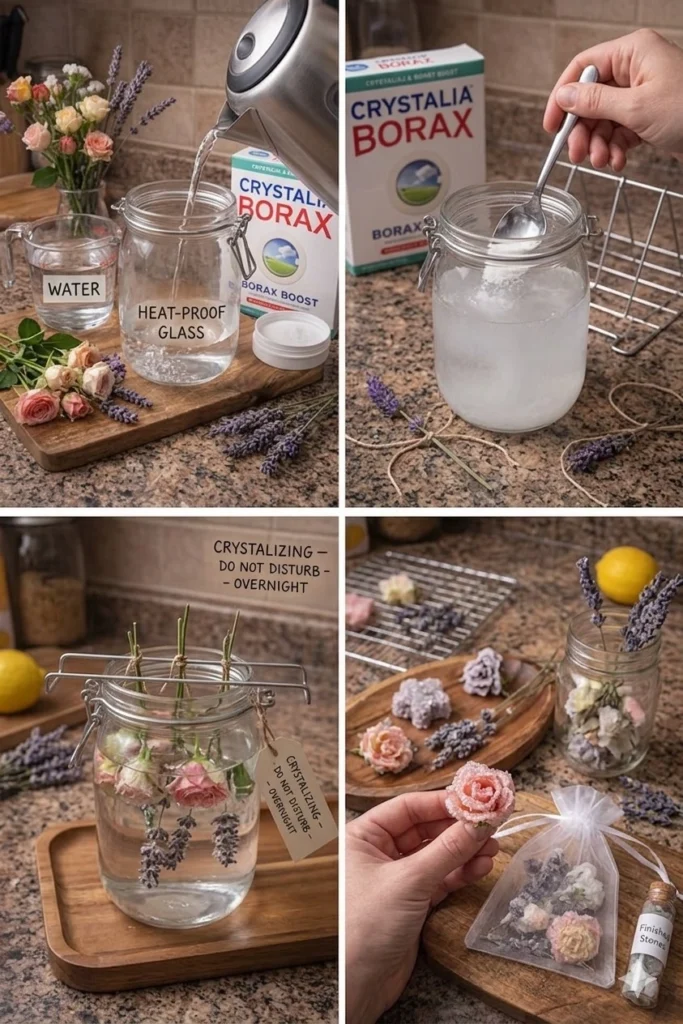
Boil water and pour it carefully into your jar or container. Add borax, stirring gently after each addition, until no more will dissolve — you’ll know you’ve reached this point when borax powder starts settling on the bottom rather than disappearing into the liquid. This fully saturated solution is the foundation of the whole experiment.
The ratio to aim for is approximately three tablespoons of borax per cup of hot water, though adding even more borax (up to saturation) produces more dramatic results.
Want colored crystals? Add a few drops of food coloring to the solution now. The crystals will take on a soft, translucent tint that looks absolutely beautiful — pale blue, soft pink, gentle purple. Choose a color that complements your flower.
Step 2: Prepare and Submerge the Flower
Tie a length of string around the stem of your flower and attach the other end to a pencil or stick long enough to rest across the top of the jar. Lower the flower gently into the solution so it hangs suspended in the middle — not resting on the bottom or sides of the container.
This suspension is important. Any surface the flower touches will produce flatter, less developed crystals. A flower hanging freely in the center of the solution grows crystals on every surface equally, producing the most dramatic, most beautiful results.
Step 3: Wait Overnight — Let the Magic Happen
Place the jar somewhere stable and undisturbed. Don’t jiggle it, don’t move it, don’t check on it every hour. Just leave it alone and let chemistry do its quiet, patient work.
This is genuinely the hardest part for most children. The anticipation is real. Lean into it — make the waiting part of the magic by talking about what might be happening inside the jar while everyone sleeps.
Step 4: Wake Up to Something Beautiful
After at least eight hours — ideally a full twelve to sixteen — carefully lift the flower out of the solution by the pencil. Hold it up to the light.
The transformation will stop you mid-breath.
Every petal, every leaf, every millimeter of stem will be coated in a dense, sparkling layer of crystals. The flower will have gone from soft and organic to mineral and glittering — like something found at the bottom of an enchanted cave, or preserved forever under glass. Each crystal catches the light from a slightly different angle, producing a constant, shifting shimmer that makes the whole flower seem to glow from within.
Set it somewhere to drip dry for an hour. Then display it somewhere beautiful.
The Science Behind the Sparkle
The magic of crystal flowers is entirely real science — and understanding it makes the experience even richer.
Why Hot Water Is Essential
Hot water can dissolve far more borax than cold water — a property called increased solubility at higher temperatures. When you dissolve as much borax as possible into boiling water, you create what chemists call a supersaturated solution — a liquid holding more dissolved material than it normally could at room temperature.
As the water cools overnight, it gradually loses its ability to keep all that dissolved borax in solution. The excess borax has to go somewhere — and it comes out of the liquid as solid crystals, attaching themselves to every available surface. The flower, with all its textured petals and tiny surface irregularities, provides thousands of perfect starting points for crystal growth.
Why Crystals Form in Such Regular, Beautiful Shapes
Borax crystals don’t form randomly. Each borax molecule connects to others in a specific geometric arrangement — the same arrangement every time, because it’s the most energetically stable configuration for those particular molecules. As more and more molecules join the growing structure, each one snapping into its designated position, the result is a crystal with a consistent, repeating geometric shape.
This is why crystals always look the same — why a borax crystal grown in a kitchen jar in one country looks identical to one grown in another country, by different people, with different water. The crystal shape is not a choice. It is the molecule’s only option.
What Makes Them Sparkle
Borax crystals are naturally transparent — they don’t absorb light, they transmit it. As light enters a crystal and passes through its internal structure, it bends slightly at each boundary — a process called refraction. Different wavelengths of light (different colors) bend by slightly different amounts, which separates white light into its component colors. This is the same process that makes a prism produce a rainbow — and it’s why crystal flowers appear to flash and sparkle with tiny rainbow colors when held up to light.
Which Flowers Work Best?
Part of the joy of this activity is experimenting — and different flowers and materials produce wonderfully different results.
Fresh flowers produce the most emotional impact — something that was alive, organic, and soft becomes permanently preserved in mineral sparkle. Roses, daisies, and wildflowers all work beautifully. Trim the stem short enough to fit in your jar without touching the bottom.
Artificial flowers are foolproof and reusable for demonstrations. Silk and fabric flowers take crystals beautifully and are available in any color or style.
Pipe cleaner flowers — shaped by hand into any floral design — produce the most spectacular crystal coverage. The fuzzy surface of the pipe cleaner provides thousands of nucleation sites, and the crystal growth is dense, dramatic, and completely uniform. If you want guaranteed stunning results, especially for a first attempt, pipe cleaner flowers are the answer.
Leaves and branches make beautiful, unexpected specimens. A single autumn leaf, crystallized and displayed on a small stand, looks like an extraordinary piece of natural art.
Feathers produce a result so beautiful it’s almost surreal — every barb coated in fine crystal, the whole feather transformed into something that looks like it belongs in a museum of natural history.
Tips for the Most Spectacular Results
Saturate fully. The more borax you dissolve, the more dramatic the crystal growth. Keep adding and stirring until borax actively settles at the bottom rather than dissolving.
Use the hottest water you can. Boiling water from a kettle is ideal. The hotter the starting temperature, the more borax dissolves, and the more crystal material is available to grow overnight.
Keep the jar completely still. Vibration disrupts crystal formation and results in smaller, less uniform crystals. Find a stable spot and don’t touch it until morning.
Leave it longer for denser crystals. Eight hours produces beautiful results. Sixteen to twenty-four hours produces dense, heavily encrusted, dramatically spectacular results. If you can wait a full day and night, do.
Try food coloring for colored crystals. Pale blue crystals on a white flower. Pink crystals on a green stem. Purple crystals on a yellow daisy. The color combinations are beautiful and completely customizable.
Add a second flower for comparison. Put one flower in the borax solution and leave another identical flower beside the jar, untreated. The comparison the next morning — one ordinary, one encrusted in crystals — makes the science even more dramatic and visible.
Crystal Flowers as Gifts and Keepsakes
One of the loveliest things about crystal flowers is that they last. Unlike real flowers, which wilt and fade within days, a crystal flower is permanent — a preserved moment, frozen in mineral sparkle.
This makes them extraordinary gifts. A rose given to someone you love, crystallized and presented in a small glass dome or on a decorative stand, is more meaningful and more lasting than a fresh bouquet. It says: I wanted to give you something beautiful that would last.
Crystal flowers also make remarkable keepsakes from significant moments. A flower saved from a wedding bouquet, a bloom picked from a garden on a meaningful day, a wildflower pressed into the hands of a child on a walk — crystallized, they become permanent, tangible memories that can be displayed and kept for years.
Display them in small glass domes, in miniature vases, mounted on decorative bases, or suspended on thread in a window where light can move through the crystals throughout the day. Each position and each light condition reveals a different aspect of their beauty.
Making It a Ritual, Not Just an Activity
The most powerful thing about crystal flowers isn’t the chemistry. It’s the structure of the experience — the doing together, the waiting together, the discovering together.
There is something genuinely special about an activity with a built-in overnight pause. It invites conversation. It creates anticipation. It gives children something to think about as they fall asleep — something to rush toward in the morning. And the discovery moment, when the jar is lifted and the sparkling, transformed flower is held up to the morning light for the first time, is one of those moments that children describe years later.
“We put a flower in a jar before bed and in the morning it was covered in crystals.”
Simple. Memorable. Entirely real.
This is what making memories looks like — not an elaborate production, not expensive supplies, not hours of preparation. Just hot water, a little borax, a flower, and the willingness to wait and see.
Make a memory today. Not just a mess.
Seasonal and Themed Variations
Spring: Use fresh garden flowers — daffodils, tulips, cherry blossoms — and tint the solution with soft pink or pale yellow. The combination of spring flower and mineral crystal is particularly beautiful.
Autumn: Crystallize fallen leaves in their orange and red and gold. The crystal coating over autumn color is spectacular — like the leaf was caught at peak beauty and preserved there forever.
Winter: Use pine branches, holly sprigs, or handmade snowflake shapes cut from pipe cleaners. Crystallized, they look genuinely like frost-covered winter botanicals.
Valentine’s Day: Crystallize red roses with a deep pink or red food coloring in the solution. A crystal rose is one of the most romantic, most distinctive handmade gifts imaginable.
Christmas: Make crystal snowflakes from pipe cleaners in star shapes and hang them in windows for decorations that genuinely sparkle in the winter light.
Final Thoughts
Crystal flowers ask very little of you. Three ingredients. Ten minutes of preparation. One night of patient sleep.
What they give back is astonishing — a flower transformed into something mineral and luminous and permanent, covered in crystals that catch every angle of light and scatter it in tiny rainbow flashes, looking for all the world like something from the deepest, most magical part of an enchanted garden.
Set it up before bedtime. Go to sleep. Wake up to wonder.
And remember: the best activities aren’t the most complicated ones. They’re the ones where science and beauty meet in a jar, and the magic happens while you’re not even looking.