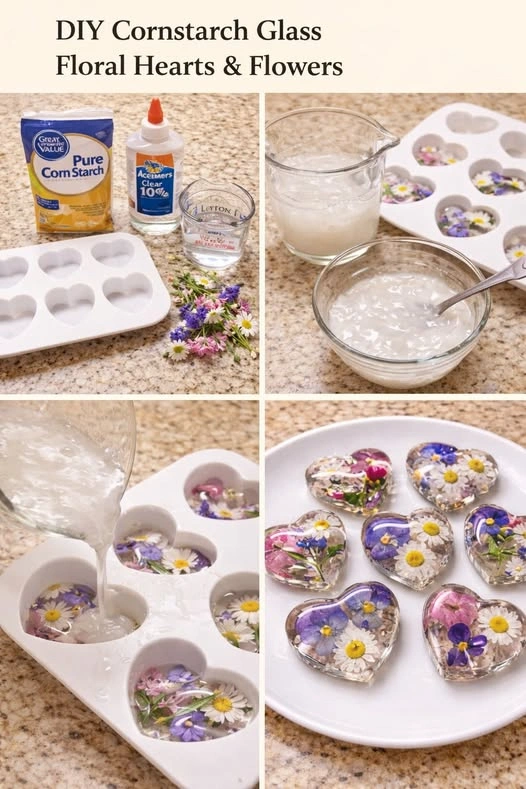
At first glance, they look like something you’d find hanging in an artisan boutique — delicate, translucent hearts and flowers in soft pink, turquoise, and purple, catching the light like tiny pieces of colored glass. Look closer and you’ll realize they’re hanging in someone’s window at home, made from nothing more than cornstarch, baking soda, water, and a little food coloring.
Cornstarch Glass Floral Hearts and Flowers are one of those crafts that produces genuinely beautiful results from laughably simple materials. The process is meditative and satisfying for adults, engaging and creative for children, and the finished pieces are stunning enough to display with pride — in windows, on walls, as gift tags, as ornaments, or strung together into garlands that fill a room with soft, colored light.
Whether you’re looking for a weekend craft project with kids, a handmade gift idea, or simply something beautiful to make for your own home, this one delivers in every way. Here’s the complete guide — step by step, tip by tip — to making the most beautiful cornstarch glass ornaments you’ve ever seen.
What Are Cornstarch Glass Floral Hearts and Flowers?
Cornstarch Glass Floral Hearts and Flowers are handmade ornaments crafted from a simple cooked dough made from cornstarch and baking soda. When shaped, colored, and dried, the dough develops a smooth, slightly translucent finish that mimics the look of frosted or sea glass — hence the “glass” in the name.
The shapes are cut with cookie cutters into hearts, flowers, and any other form you choose. A hole punched before drying allows them to be strung on ribbon, twine, or thread. Tinted with food coloring in soft, layered hues, the finished pieces glow gently when light passes through them — especially beautiful in a sunny window or near a lamp.
They’re part craft, part science experiment, and entirely stunning. And unlike many crafts that require specialty materials or advanced skills, these are genuinely accessible to anyone with a saucepan and a rolling pin.
What You’ll Need
For the dough:
- 1 cup cornstarch — The structural foundation of the recipe. Cornstarch is what gives the finished pieces their smooth, fine-textured surface and their slightly translucent quality.
- 1 cup baking soda — Works with the cornstarch to create a workable, clay-like dough. Also contributes to the smooth, matte surface finish.
- ¾ cup water — Binds everything together during cooking.
For shaping and decorating:
- Food coloring — Pink, turquoise, and purple are the classic choices for a soft, jewel-toned palette, but any colors work beautifully.
- Heart and flower cookie cutters — Standard metal or plastic cookie cutters work perfectly.
- Parchment paper — For rolling and drying without sticking.
- A saucepan — For cooking the dough on the stovetop.
- A spoon — For stirring during cooking.
- A rolling pin — For rolling the dough to an even thickness.
- A straw or toothpick — For punching the hanging hole.
Optional but wonderful additions: fine glitter mixed into the dough for a subtle sparkle, metallic food coloring for a gilded effect, ribbon or twine for hanging, and a fine paintbrush for applying color in thin, translucent layers after drying.
Step-by-Step Instructions
Step 1: Mix the Ingredients
In your saucepan — before turning on any heat — combine one cup of cornstarch, one cup of baking soda, and three quarters of a cup of water. Stir everything together until smooth and completely lump-free. Starting with a smooth mixture before heating is important; lumps that form in the cold mixture become much harder to work out once heat is applied.
Take your time here. A well-mixed base produces a smoother, more even dough that rolls out beautifully.
Step 2: Cook on Low Heat
Place the saucepan over low heat and stir continuously. This is not a step to rush or walk away from — the mixture goes from liquid to dough relatively quickly once it begins to thicken, and stirring constantly prevents lumps and ensures even heating throughout.
As the mixture heats, you’ll see it gradually thicken from a milky liquid to a paste, then to a soft, dough-like consistency. When it begins to pull away from the sides of the pan and holds together in a ball, it’s ready. Remove it from the heat immediately — overcooking will make the dough dry and crumbly.
The whole process takes roughly five to ten minutes on low heat.
Step 3: Cool Until Handleable
Transfer the dough to a plate or piece of parchment paper and let it cool. Fresh out of the pan it will be too hot to handle comfortably. Give it ten to fifteen minutes, then test it — you want it warm enough to be pliable but cool enough that you can work with it without discomfort.
Cover it loosely with a damp cloth while it cools to prevent the surface from drying out prematurely.
Step 4: Add Color
This is where the magic really begins. Divide your dough into as many portions as you have colors. Add a few drops of food coloring to each portion and knead it in thoroughly until the color is even and consistent throughout.
For the translucent glass effect, keep your colors relatively light — more pastel than vivid. Heavily saturated colors look beautiful but block more light, reducing the translucent quality. Soft pinks, watery turquoises, and pale purples let the most light through and give the most convincing “stained glass” appearance.
If you want a marbled effect, fold two colors together just two or three times — enough to create swirls without fully blending.
Step 5: Roll Out the Dough
Working one color at a time, place your dough between two sheets of parchment paper and roll it out to approximately one quarter of an inch thick. Using parchment above and below prevents sticking and produces a smoother surface on both sides of the finished piece.
Roll as evenly as possible — variations in thickness will cause uneven drying and can lead to warping. Take your time and use long, smooth strokes with the rolling pin.
Step 6: Cut Your Shapes
Press your cookie cutters firmly and cleanly into the rolled dough. Lift each shape carefully and transfer it directly onto a clean sheet of parchment paper where it will dry undisturbed.
Gather the remaining scraps, knead them briefly back together, and re-roll to cut more shapes. Continue until you’ve used all your dough.
Flower cutters, heart cutters, star cutters, butterfly cutters — any shape works. The most delicate and intricate designs tend to be the most beautiful once translucent, but simpler shapes are easier to handle for younger crafters.
Step 7: Punch the Hanging Holes
Before the dough begins to firm up, use a straw or toothpick to punch a clean hole near the top of each shape. Press straight through and wiggle very slightly to widen the hole just enough for ribbon or twine to pass through. Position the hole close enough to the edge to look intentional but not so close that it risks cracking during drying.
If the hole closes slightly as you remove the straw, reinsert it and widen again. The dough is forgiving at this stage.
Step 8: Dry for 24 to 48 Hours
Place your finished shapes on parchment paper in a single layer with space between each one and leave them to air dry completely. This takes anywhere from 24 to 48 hours depending on the thickness of the pieces and the humidity of your environment.
Importantly — flip each piece gently after about 12 hours. Drying on one side only causes the top to dry and harden while the bottom remains soft, which creates a curve or warp. Flipping partway through ensures even drying and flat, straight finished pieces.
As they dry, watch the transformation happen: the surface becomes smooth, the texture firms from clay-like to almost ceramic, and the color lightens slightly to that soft, translucent quality that makes these pieces look so remarkable near a light source.
The Science Behind the Glass Effect
The stunning visual quality of these ornaments isn’t accidental — it’s a direct result of what happens to the materials at a molecular level during cooking and drying.
How Cooking Changes Cornstarch
Raw cornstarch is a fine white powder made of tightly packed starch granules. When these granules are combined with water and heated, a process called gelatinization occurs. The starch granules absorb water, swell, and eventually burst, releasing their starch molecules into the liquid. These molecules then form a continuous network — a gel — that gives the cooked mixture its thick, dough-like consistency.
As the cooked dough dries, the water evaporates and the starch molecules pack more closely together, forming a solid, smooth matrix. This packing creates a surface that is denser and more uniform than dried raw cornstarch would be — which is what gives the finished pieces their smooth, almost polished appearance.
Why the Finished Pieces Are Translucent
The translucent quality comes from the fact that the dried cornstarch-baking soda matrix, while solid, is not fully opaque. The tightly packed starch molecules allow some light to pass through rather than reflecting all of it back — similar to the way frosted glass or parchment paper allows diffused light through while still providing structure.
The thinner the piece, the more translucent it is. This is why rolling to exactly one quarter of an inch is recommended — thin enough for good light transmission, thick enough to remain structurally sound.
What Baking Soda Contributes
Baking soda (sodium bicarbonate) is slightly alkaline and very fine in texture. Mixed into the dough, it moderates the pH of the mixture, contributes to the smooth surface finish, and adds a slight opacity that, paradoxically, enhances the frosted glass look rather than diminishing it. The interaction between the cornstarch and baking soda during cooking also affects the texture of the final dough, making it more pliable and less likely to crack during shaping.
Why This Craft Is Worth Making
The Results Are Genuinely Beautiful
This is not a craft where you squint and try to see the charm through a veil of good intentions. The finished pieces are legitimately stunning — the kind of thing visitors notice and ask about. A cluster of pink and purple hearts hanging in a sunny window, glowing softly with transmitted light, looks like something from a professional home decor catalog.
It’s Meditative for Adults, Engaging for Kids
The cooking and rolling stages are calming and focused — a welcome change from the pace of everyday life. The cutting and coloring stages are perfect for children. And watching the pieces transform over the drying period, checking on them every few hours, builds anticipation in the best possible way.
It Makes Exceptional Handmade Gifts
Strung on a length of satin ribbon or twine, a set of these ornaments makes a beautiful, genuinely handmade gift that requires minimal materials but conveys enormous care and thoughtfulness. Gift tags, Christmas ornaments, Valentine’s Day hearts, Mother’s Day flowers — the same basic craft adapts to any occasion simply by changing the shape and color palette.
It Encourages Creative Exploration
Once kids understand the basic technique, they begin experimenting instinctively. What happens if you swirl two colors? What if you add glitter? What if you use a tiny cutter for miniature shapes? What if you stack two translucent colors? Every question is worth pursuing, and the answers are always interesting.
Expert Tips for the Most Beautiful Results
Don’t rush the cooking. Low and slow is the key. Rushing by turning up the heat creates uneven cooking, lumps, and a dough that’s harder to work with. Keep the heat low and stir constantly.
Roll between parchment, always. Rolling directly on a surface causes sticking and tearing. Two sheets of parchment paper give you a clean, even roll every time and produce a smoother surface on the finished pieces.
Keep the dough covered. When you’re not actively working with a portion of dough, keep it covered with a damp cloth. Exposed surfaces dry out quickly and become crumbly.
Apply color in light layers for translucency. For the most glass-like effect, use less food coloring than you think you need. You can always add more, but you can’t remove it once it’s kneaded in.
Flip during drying — without fail. Skipping the flip is the most common cause of warped pieces. Set a reminder at the twelve-hour mark if needed.
Sand smooth after drying. If you notice any rough edges or slight surface imperfections after drying, very fine sandpaper (400 grit or higher) can smooth them out beautifully without damaging the piece.
Seal with mod podge for longevity. A thin coat of Mod Podge or clear craft sealant applied after full drying protects the pieces from humidity and handling, and adds an extra glossy or matte finish depending on the formula you choose.
Creative Variations to Try
Pressed Flower Inlays: Press a small dried flower or leaf into the surface of each piece before drying. As the dough hardens around it, the flower becomes embedded in the piece — visible through the translucent surface like a botanical specimen in glass.
Layered Color Effect: Roll two very thin sheets of different-colored dough and layer them before cutting. The resulting pieces have a subtle gradient of color from one side to the other.
Gold and Silver Accents: After drying, paint thin lines, dots, or borders with gold or silver metallic paint for a gilded, artisan look.
Miniature Wreaths: Use a large round cutter and a smaller round cutter to create ring shapes. Embellish the surface with tiny flowers cut from the same dough before drying for a wreath effect.
Garland Stringing: Make thirty to fifty small hearts and flowers, string them at intervals along a length of twine, and hang the garland across a window or mantelpiece for a stunning decorative feature.
Seasonal Palettes: Deep red and gold for Christmas. Soft yellow and lavender for spring. Orange and cream for autumn. Black and silver for Halloween. The same technique adapts to every season simply by changing the colors.
Displaying Your Finished Pieces
A sunny window is the single best place for these ornaments. Backlit by natural light, the translucent colored dough glows in a way that makes them look genuinely extraordinary. String them at different heights on fishing line for a barely-there hanging effect.
Grouped on a windowsill, arranged on a wreath, tied as gift tags, hung from a chandelier, or strung on a garland — there’s almost no wrong way to display them. The only requirement is that they be seen by light.
Store any pieces not on display in a cool, dry place. Humidity is the enemy of cornstarch dough crafts — keep them away from kitchens and bathrooms where steam and moisture can soften the surface.
Final Thoughts
Cornstarch Glass Floral Hearts and Flowers are proof that the most beautiful things are often the simplest ones — made with patience, a little heat, and the willingness to let something transform in its own time.
From a saucepan of white powder and water emerges something that looks like colored glass, catches the light like a gemstone, and hangs in a window like a tiny work of art. The process is accessible to anyone, the materials cost almost nothing, and the results are genuinely, consistently stunning.
Make them for your windows. Make them as gifts. Make them with kids on a quiet weekend afternoon, and watch those same kids check on the drying pieces every hour with something that looks a lot like impatient, joyful anticipation.
The light will do the rest.