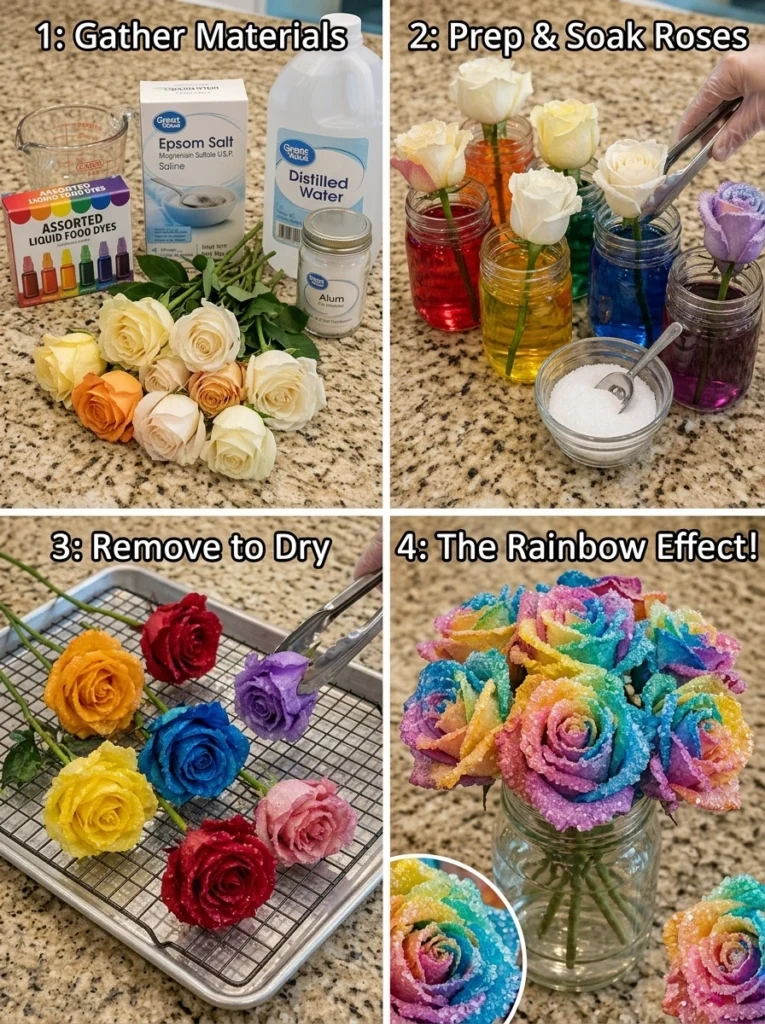
Picture a rose — but not quite like any rose you’ve seen before. The petals are still soft, still shaped exactly as a rose should be, but every surface is covered in a dense, glittering coat of crystals that catch the light from every angle. In pink. In blue. In deep violet and warm gold. A full bouquet of them, each a different color, each sparkling like a jewel in a vase — and every single one started as an ordinary fresh rose from a grocery store.
Rainbow Crystal Roses are one of those projects that sits at the perfect intersection of science and beauty. The process is simple. The wait is overnight. And the results are so genuinely, unexpectedly stunning that people who see the finished roses for the first time consistently refuse to believe they were made at home.
They look like they belong in a fairy tale florist’s window. They look like something a jeweler and a botanist made together. They look, in short, like magic — and the science behind them is just as fascinating as the finished product.
Here is the complete guide to making the most beautiful rainbow crystal roses you’ve ever seen.
What Are Rainbow Crystal Roses?
Rainbow Crystal Roses are real fresh roses — soaked in a saturated solution of Epsom salt, alum powder, and colored water — that emerge covered in a sparkling coat of crystals. The crystalline coating grows directly onto the petals and stem as the rose soaks in the solution and then dries, transforming the flower into a permanent, mineral-encrusted sculpture that preserves its shape while giving it an entirely new, luminous surface.
Unlike artificial flowers dipped in glitter or wax, crystal roses have genuine texture and depth. Each crystal is a real, geometric structure grown on the surface of the petal — and up close, the detail is extraordinary. The crystals vary in size across the surface of the flower, clustering more densely in some areas and more sparsely in others, just as crystals grow in nature. The flower retains its form — every petal curve, every layered bloom — while gaining a surface that sparkles and shifts with every change of light.
They make breathtaking display pieces, extraordinary handmade gifts, stunning photography subjects, and one of the most memorable science activities you can do at home. A vase of rainbow crystal roses on a windowsill in morning light is a genuinely spectacular sight.
What You’ll Need
For the crystal solution:
- Fresh roses — White or very pale roses give the most vivid color results, since the food coloring tints both the solution and, over the soaking period, the petals themselves. Pink, cream, or ivory roses also work well. Deep red or dark-colored roses will show less color differentiation but still develop beautiful crystals.
- Epsom salt — Magnesium sulfate heptahydrate — the classic bath salt found in any pharmacy or grocery store. Epsom salt forms large, faceted crystals that are clearly visible on the petal surface and catch light beautifully.
- Alum powder — Potassium alum, available in the spice aisle of most grocery stores or online. Alum dramatically improves crystal adhesion to the rose petals — acting as a mordant that helps the crystal structure grip the organic surface of the flower rather than sliding off.
- Warm distilled water — Distilled water is preferred over tap water because minerals and chlorine in tap water can interfere with crystal formation and produce cloudy or inconsistent results. Warm water dissolves the salts more readily and produces a more saturated solution.
- Food coloring — Gel food coloring produces the most vivid, saturated colors. Liquid food coloring works well and is more widely available. Use one color per jar for distinct, bold roses — or experiment with combining colors for gradient effects.
For the process:
- Small jars or cups — One per rose. Wide-mouth mason jars or large drinking glasses work perfectly. The vessel needs to be tall enough for the rose stem to be submerged while the bloom rests above the solution.
- A measuring cup — For consistent proportions across multiple jars.
- Tongs — For removing roses from the solution without disturbing the early crystal formation on the stems.
- A drying rack — For supporting roses upright or suspended during the drying and crystal-forming stage.
Step-by-Step Instructions
Step 1: Prepare the Roses
Begin by trimming each rose stem at an angle — a diagonal cut rather than a straight one — which increases the surface area available for absorbing the solution and helps the rose take up the colored water more efficiently. Remove any leaves that would sit below the waterline in the jar, as submerged leaves can cloud the solution and reduce crystal formation quality.
Leave a few leaves near the bloom if you want them to develop crystals too — leaf surfaces accept crystal growth beautifully and add to the overall effect.
If the roses are fresh from a store, give them a couple of hours in plain clean water first to fully hydrate before transferring to the crystal solution. A well-hydrated rose will absorb the colored solution more efficiently and the petals will be more flexible and less likely to bruise during handling.
Step 2: Prepare the Crystal Solutions
Fill each jar with warm distilled water — approximately one cup per jar is a good working volume for a single rose. Add your food coloring first and stir to combine, then assess the depth of color. For bold, vivid crystal roses, you want the solution quite deeply colored — the rose will absorb some of the color into its petals, and the crystals that form will carry the color as well. If the solution looks too pale, add more coloring until it reaches a rich, saturated hue.
Now add the Epsom salt. Add it gradually — two to three tablespoons at a time — stirring after each addition until fully dissolved before adding more. Keep adding until the salt begins to settle at the bottom rather than dissolving — this saturation point is your target. A fully saturated solution contains as much dissolved Epsom salt as the water can hold, which maximizes the amount of crystal material available to deposit on the rose during soaking.
Add one generously heaped teaspoon of alum powder per cup of water and stir until mostly dissolved. Alum doesn’t dissolve as cleanly as Epsom salt and some cloudiness in the solution is normal — this won’t affect the results.
Prepare a separate jar with a different color for each rose you’re making. For a rainbow set, prepare six jars: red, orange, yellow, green, blue, and purple. For a more curated palette, two or three complementary colors in a single color family can be equally beautiful.
Step 3: Soak the Roses
Place one rose in each prepared jar, stem down, so that the stem is submerged in the solution while the bloom and upper petals sit above the waterline. The rose should be stable in the jar — if it tips, adjust the stem length or wedge it gently against the side.
Position the jars somewhere they won’t be disturbed — a counter, a shelf, or a windowsill away from direct sunlight works well. Room temperature is ideal; warm temperatures speed up the soaking process but can also soften and wilt the petals.
Allow the roses to soak for 12 to 24 hours. During this time, two things are happening simultaneously: the rose is absorbing the colored solution through its stem, tinting the petals from within, and the solution is beginning to deposit early-stage crystals on any surfaces it is in contact with — the stem, the lower petals, and the surfaces of the solution.
Check on them at the 12-hour mark. If the petals have taken on visible color, the rose is ready. If the coloring seems light or the petals look unchanged, allow another 6 to 12 hours. Don’t worry if the solution looks slightly cloudy or if you see crystal formation beginning on the stem — both are signs the chemistry is working.
Step 4: Remove and Place on the Drying Rack
After soaking, remove each rose from its solution using tongs — handle gently, as the early crystal formation on the stem is fragile and can be disrupted by rough handling. Hold the rose over the jar briefly to allow excess solution to drip back, then transfer it to the drying rack.
Position each rose so that air can circulate freely around the bloom — supported upright if your rack allows, or suspended at an angle. The goal is maximum air exposure to all surfaces of the flower to promote even drying and uniform crystal development.
Keep different colored roses separated on the rack to prevent any cross-contamination of colors as drips fall from the petals during the early drying phase.
Step 5: Dry Fully and Watch the Crystals Form
This is the most magical stage — and the one that requires the most patience. Set the roses aside in a dry, well-ventilated area and allow them to dry completely. Full drying typically takes 24 to 48 hours, though larger, denser blooms may take longer.
As the roses dry, the water in the solution coating each surface evaporates, leaving behind the dissolved salts in crystalline form. The crystals grow slowly and continuously as drying progresses — starting small and building up into the visible, faceted structures that give the finished roses their extraordinary appearance.
Check on them every few hours without touching them — the growing crystals are delicate at this stage and handling can dislodge them before they’ve fully hardened. What you’ll observe is a gradual transformation: first a faint shimmer on the petal surfaces, then visible crystal points beginning to catch the light, then dense, glittering coverage that builds from the outer petals inward.
The crystals are fully formed and hardened when the surface of each petal looks consistently encrusted — no visible wet or bare patches, and the crystals feel firm rather than soft when you very gently touch one with a fingertip.
Step 6: Arrange and Display
Once fully dried, handle the crystal roses with care. The crystals are beautiful but brittle — they can crack or flake if the petals are squeezed or bent. Hold each rose by the stem when moving it, and lower it gently rather than placing it with any force.
Arrange your crystal roses in a dry vase — no water, as moisture will slowly dissolve the crystal coating. A glass vase allows the colored stems and lower leaves to be seen. A ceramic or opaque vase focuses attention on the blooms.
Position them near a window where light can move across the crystal surfaces throughout the day. A crystal rose in morning light is a completely different experience from the same rose in afternoon light or lamplight — the angles from which the crystals catch and scatter light change as the light source moves, and each change reveals new color and new sparkle.
A full rainbow set — six roses in red, orange, yellow, green, blue, and purple — arranged together in a wide-mouthed vase is, without qualification, one of the most visually spectacular things you can put on a shelf or a table.
The Science of Crystal Growth
The rainbow crystal rose is a beautiful demonstration of some fundamental chemistry — and understanding what’s happening inside each jar makes the whole process more fascinating.
Supersaturation and Crystal Precipitation
The foundation of this experiment — as with all crystal-growing activities — is the concept of supersaturation. Hot or warm water can dissolve significantly more salt than cold water can. When you dissolve as much Epsom salt as possible in warm water, you create a supersaturated solution — a liquid holding more dissolved material than it could hold at room temperature.
As the solution cools to room temperature and then as the water evaporates during the drying phase, the solution’s capacity to hold dissolved salt decreases. The excess salt has nowhere to go except out of the solution — and it exits as solid crystals, attaching to any available surface and growing in the ordered, geometric structures characteristic of each compound.
Epsom salt crystals (magnesium sulfate) are naturally colorless and transparent, but they grow large enough to be clearly visible to the naked eye — faceted, needle-like or prismatic structures that catch and refract light beautifully. When grown on a surface that has been tinted with food coloring, the crystals take on a hint of that color, especially in the thinner, more translucent areas of each crystal.
What Alum Does
Alum (potassium alum) serves a dual purpose in this recipe. First, it provides an additional source of crystal material — alum forms its own distinctive crystal structures (octahedral, or double-pyramid shaped) that mix with and supplement the Epsom salt crystals. Second, and more importantly for this application, alum acts as a mordant.
A mordant is a substance that forms a chemical bridge between a surface and another material — in textile dyeing, mordants are used to fix dyes to fabric. In this application, alum helps the crystal layer adhere to the organic surface of the rose petal rather than simply coating it loosely and falling off when dry. The alum essentially makes the petal surface chemically receptive to crystal attachment, producing a more durable and dense crystal coating than Epsom salt alone would achieve.
How the Color Gets into the Petals
Roses are alive and actively transporting water through their stems and into their petals while soaking. The colored solution enters through the cut stem and travels up through the vascular system of the rose — the same system that carries water and nutrients from the soil in a living plant — distributing the colored water throughout the flower.
This is the same process used to color carnations and daisies for science demonstrations, but here it serves a dual aesthetic purpose: the petals are tinted from within by the absorbed color, and the crystal coating on the outside carries the same color from the solution. The result is a rose that is colored all the way through — petals, stem, and crystal surface all unified by the same hue.
Why Crystal Roses Are Extraordinary
They’re Genuinely Permanent
Unlike fresh flowers, which wilt and fade within days, crystal roses are permanent. The crystal coating essentially preserves the form of the rose — the petals hold their shape, the colors remain vivid, and the crystals continue to catch the light indefinitely. A crystal rose displayed in a dry environment can last for months or years without any maintenance.
The Science Is Real and Teachable
Every stage of this project is a real chemistry experiment — supersaturation, crystal nucleation, crystal growth, capillary action, mordanting. Children who make crystal roses encounter all of these concepts in a hands-on, visual, meaningful way. The overnight wait builds anticipation; the gradual crystal formation is visible and checkable; the final reveal is deeply satisfying. This is exactly the kind of experience that makes science feel exciting and personal rather than abstract and distant.
They’re Exceptional Gifts
A single crystal rose, carefully made and presented in a small vase or glass dome, is one of the most unusual and beautiful handmade gifts imaginable. Unlike most gifts, it’s simultaneously functional as decor, scientifically interesting, and genuinely rare — most people have never seen one and will immediately ask how it was made. A set of rainbow crystal roses is a gift that people display and keep.
Every One Is Unique
Because crystal growth is governed by the specific conditions of each jar — the exact concentration of solution, the temperature, the humidity, the surface texture of each petal — no two crystal roses ever look exactly the same. The size, distribution, and density of crystals varies naturally from rose to rose and from area to area on each bloom. This natural variation is part of what makes them look real and organic rather than manufactured.
Tips for the Most Spectacular Results
Use white or very pale roses. White roses produce the most vivid, true-to-color results because there’s no underlying petal color to compete with or alter the food coloring. Pale pink or cream roses work nearly as well. Deep red or dark pink roses will show coloring but with less clarity and vibrancy.
Fully saturate the solution. Don’t be conservative with the Epsom salt. A solution that has reached full saturation — where salt actively settles at the bottom no matter how much you stir — produces significantly more dramatic crystal growth than a dilute solution.
Use distilled water. The minerals and chlorine in tap water compete with the Epsom salt and alum for crystal formation and can produce cloudier, less well-formed crystals. Distilled water is inexpensive and makes a visible difference in crystal quality.
Don’t skip the alum. The difference in crystal adhesion between roses processed with alum and those without is significant. Without alum, many crystals will flake off during drying. With alum, the coating is dense, adhered, and durable.
Give them space on the drying rack. Roses touching each other during drying will fuse together where the crystal solutions mix at the contact points. Space them with room to breathe.
Handle only by the stem after drying. The crystals on the petals are beautiful but fragile. Touching or pressing the petals can dislodge whole sections of crystal. Once dried, treat them as the delicate sculptures they are.
Creative Variations to Try
Ombre roses: Soak a rose in one color for 12 hours, then transfer it to a second, related color for another 6 hours. The petals will show a gentle gradient from one color to the other.
Two-tone solutions: Mix two colors in the same jar — blue and red for purple, red and yellow for orange — for roses in colors that don’t come in standard food coloring sets.
Full crystal bouquet: Make roses in every color of the rainbow and arrange them together. The combined effect of six or seven different colors, all sparkling simultaneously in a vase, is genuinely extraordinary.
Preserved rose keepsakes: Start with a rose that has personal significance — from a birthday, an anniversary, a garden that matters — and crystallize it as a permanent memento. Presented in a glass dome or small shadow box, it becomes a keepsake that lasts indefinitely.
Crystal leaves and foliage: Soak individual leaves, fern fronds, or small branches in the Epsom salt solution separately and allow them to dry as crystal-coated foliage. Arranged with the crystal roses, they create a complete crystal garden arrangement.
Final Thoughts
Rainbow Crystal Roses are a reminder that science and beauty are not separate things — that the same chemistry that produces industrial crystals and pharmaceutical compounds can, with the right materials and a little patience, produce something that takes your breath away.
A fresh rose, a jar of colored water, a night of soaking, a day of drying. And then a flower covered in crystals — glowing pink, electric blue, deep violet, warm gold — that catches every angle of light and returns it as something more beautiful than it received.
Arrange them in a vase near a window. Watch them change through the day as the light moves. Give a single one to someone you love.
They began as an ordinary rose. They became something that lasts.